
Locate the place
 BhutanMyanmarBangladeshChina
 China
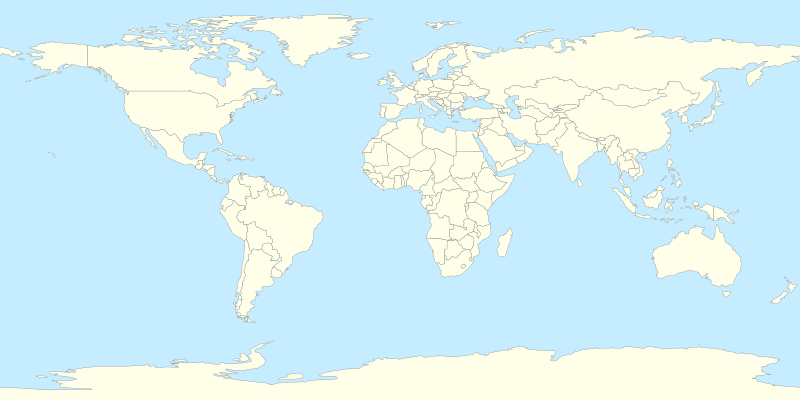
ChinaMarker uses stored geographic coordinates on equirectangular location-map bounds. India map bases: Wikimedia Commons / Uwe Dedering (CC BY-SA 3.0). World political base: public domain; physical world base: Gundan (CC BY-SA 4.0).
📌 Why in News?
Recent policy analyses highlight critical minerals as central to industrial strategy, national security, clean energy, defence, and digital technologies. Published on August 4, 2026, assessments emphasize that with global supply chains heavily concentrated in specific geographic regions, access to raw and refined materials has transformed into a cornerstone of geopolitical power and economic sovereignty.
Syllabus & Relevance
Prelims Domain: Economic and Social Development - Sustainable Development, Poverty, Inclusion, Demographics, Social Sector Initiatives.
GS Paper/Topic: GS-3 - Infrastructure: Energy, Ports, Roads, Airports, Railways, etc., and Effects of Liberalization on the Economy.
Current-Static Link: Securing critical raw materials for green energy transition, high-tech manufacturing, and strategic autonomy.
Why it matters for India
India's clean energy, advanced manufacturing, and net-zero goals heavily rely on critical minerals like lithium, cobalt, and nickel.
Securing these supply chains protects India's economic sovereignty against foreign export controls, reduces import dependence, and fuels domestic industrial growth.
Static Foundation
Critical minerals are non-fuel mineral elements essential for clean energy transition technologies, semiconductors, telecommunications, aerospace, and advanced defense systems.
Global supply chains for critical minerals show extreme geographic concentration in mining and processing.
Midstream processing involves chemical purification, smelting, and turning raw ore into high-purity inputs for high-tech manufacturing.
Renewable energy applications include EV batteries, solar photovoltaic cells, and wind turbines.
Defence applications rely on high-strength permanent magnets and specialized alloys for guidance systems and radars.
Data, Reports, Cases & Examples
The average global market share of the top three refining nations for copper, lithium, nickel, cobalt, graphite, and rare earths rose to 86%, with China leading refining in 19 out of 20 strategic minerals.
China processes over 90% of global rare earths and graphite, nearly 75% of cobalt, and 70% of lithium chemicals, creating a strategic midstream monopoly.
Current copper project pipelines point to a 30% global supply shortfall by 2035, alongside impending lithium and rare earth deficits.
Under a Net-Zero 2070 scenario, India's cumulative demand for energy transition minerals will reach roughly 169 million tonnes, representing a 51% increase over current policy pathways.
KABIL (Khanij Bidesh India Limited) secured 15,703 hectares in Argentina's Catamarca province for lithium exploration and joint development.
The central government approved a ₹1,500 crore incentive scheme for critical mineral recycling.
Prelims Quick Facts
Definition: Critical minerals are non-fuel mineral elements essential for clean energy transition technologies, semiconductors, telecommunications, aerospace, and advanced defense systems.
Refining Monopoly: China processes over 90% of global rare earths and graphite, nearly 75% of cobalt, and 70% of lithium chemicals.
Supply Deficits: Current copper project pipelines point to a 30% global supply shortfall by 2035.
India Demand: Cumulative demand for energy transition minerals under a Net-Zero 2070 scenario will reach roughly 169 million tonnes.
KABIL Asset: KABIL secured 15,703 hectares in Argentina's Catamarca province for lithium exploration.
National Mission: The National Critical Mineral Mission (NCMM) targets 1,200 domestic exploration projects by 2030-31.
Trap: It is incorrect to assume India is completely devoid of raw mineral reserves; India possesses raw reserves of copper, graphite, and monazite, but lacks midstream processing capabilities.
Trap: Critical minerals are not exclusively used for consumer electronics; they are critical inputs for national defense systems, aerospace, and clean energy infrastructure.
Mains-only layer✍️ Open Mains Perspective & Answer FrameworkClick to expand ↓
Mains Perspective
Background
Critical minerals have rapidly gained geopolitical prominence due to their indispensable application in high-tech manufacturing, electronics, defence equipment, and renewable energy technologies such as electric vehicles and wind turbines. Policy analyses underline that clean energy transition, defence, and digital technologies drive the central role of these minerals in modern industrial strategy.
Significance
Control over the supply and processing of critical minerals underpins modern economic strength and strategic autonomy, reducing external vulnerabilities in global trade. Securing these minerals fuels clean energy transitions, powers high-tech semiconductor manufacturing, strengthens strategic defence and aerospace applications, and protects economic sovereignty against foreign export controls.
India-specific Implications
India's long-term demand surge under a Net-Zero 2070 scenario requires 169 million tonnes of energy transition minerals. However, India faces high import dependence for primary lithium, cobalt, and nickel, making supply weaponization by dominant producers a major risk to domestic EV gigafactories and manufacturing corridors.
Challenges and Criticisms
Global supply chains are concentrated in specific geographic regions, raising concerns over supply disruptions, price volatility, and geopolitical leverage. Domestically, India suffers from a lack of high-purity processing capabilities, shallow exploration depths, prolonged regulatory and environmental clearances, limited private sector participation, nascent recycling ecosystems, and challenging remote location economics.
Way Forward
Nations must diversify sourcing, invest in domestic exploration and processing capabilities, foster international partnerships, and promote recycling technologies. Key measures include prioritizing midstream refining through infrastructure status and production-linked incentives, establishing physical strategic reserves, de-risking private capital with geological data, accelerating closed-loop circular recycling under EPR, and deepening multilateral partnerships like the India-U.S. Strategic Critical Minerals Cooperation Framework and Quad initiatives.
Answer Framework
Introduction: Define critical minerals and state their emergence as foundational currencies of modern economic power, clean energy security, and national defence. Body: Discuss their significance in driving clean energy, high-tech manufacturing, and defence. Analyse supply-chain risks such as extreme geographic concentration and India's import dependencies. Outline strategic countermeasures including the National Critical Mineral Mission, KABIL foreign asset acquisitions, MMDR Act amendments, recycling schemes, and multilateral alliances
Conclusion
Emphasize that translating raw potential into industrial capability through scaling midstream refining is vital for India's technological sovereignty.
Possible Mains Question
How can critical mineral security influence India's aspirations of becoming a global manufacturing hub? Analyse the major supply-chain risks confronting the country. What should be the key elements of a comprehensive critical minerals strategy?