Map focus
22.80°, 79.00° · maps only where geography mattersIndia
CountryIndia
India locator
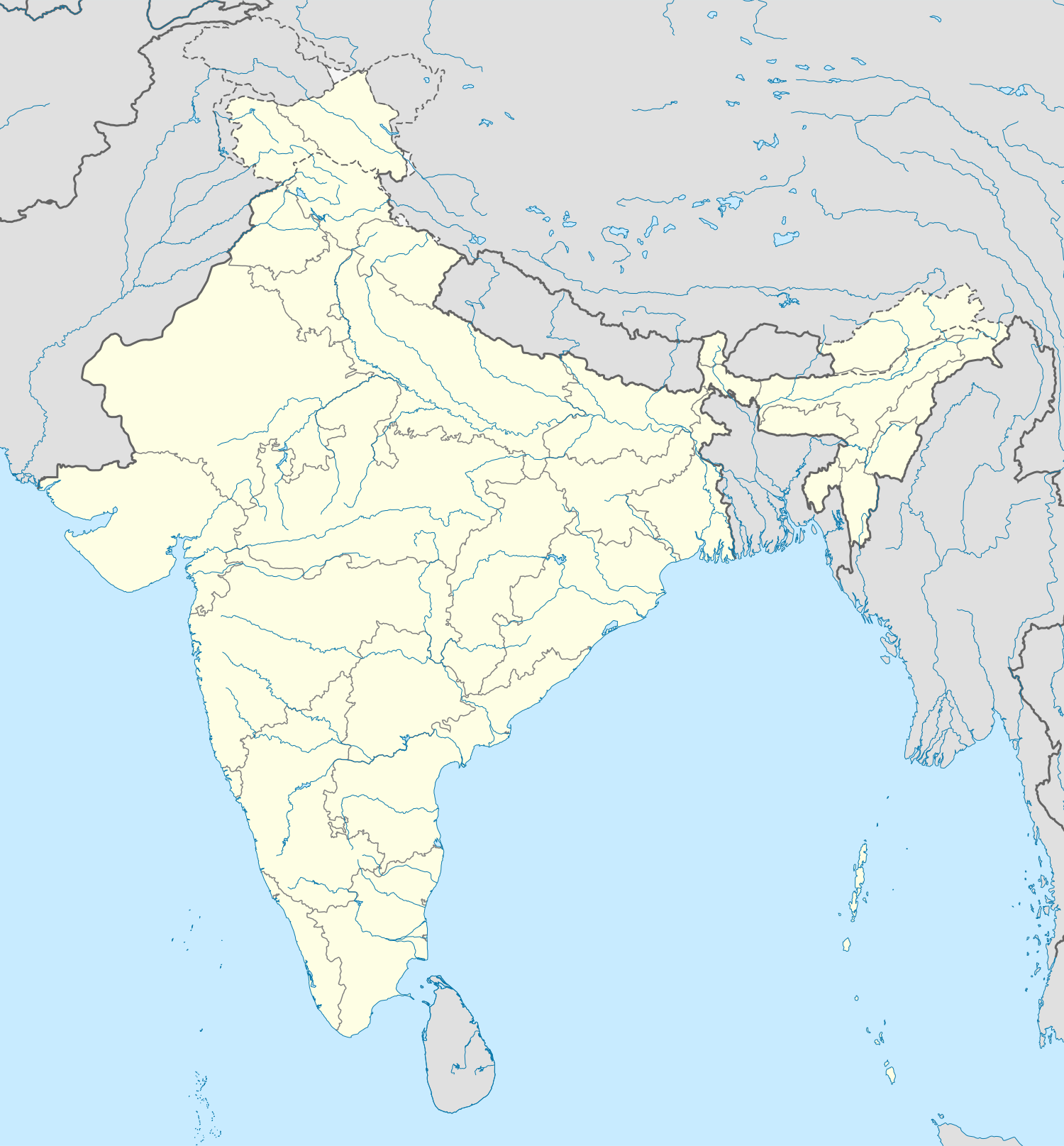 India
India📌 Why in News?
CURRENT **AFFAI****RS 37 **Districts as Export Hubs: Localising India's Global Trade Strategy Category: Economy, MSMEs, Trade and Regional Development | GS: GS Paper II, GS Paper III | Date: 2 September 2026 WHY IN NEWS
- A September 2026 PIB backgrounder highlighted Districts as Export Hubs as a framework for making every district a unit of export planning.
- The initiative identifies locally competitive products and services, prepares District Export Action Plan s and links producers with loGIstics, standards, finance and global markets.
- The policy attempts to correct the geographic concentration of India's exports in established industrial clusters and port cities by brinGIng small towns, rural districts and specialised local products into export value chains.
- For UPSC , DEH links foreign trade, MSMEs, cooperative federalism , district administration, ODOP , loGIstics, GI products, employment and balanced reGIonal development. TOP DATA & FACTS FOR UPSC u India's total exports of goods and services reached about US$825.25 billion in 2024
- 25 and were estimated at about US$863.11 billion in 2025
- 26 in the September 2026 PIB backgrounder. u DEH treats each district as a unit of export planning, not merely production. u State Export Promotion Committees and District Export Promotion Committees have been constituted across all 36 States/UTs. u By March 2026 , draft District Export Action Plan s had been prepared for 590 districts , with 249 formally notified by respective district committees. u DEH builds on the One District One Product approach while adding export-market, infrastructure and institutional planning. u Examples identified in official material include Jalgaon banana, Bastar iron craft, ceramics and potato in Sabarkantha, and oranges in parts of Madhya Pradesh. u Export competitiveness depends on standards, testing, packaGIng, certification, loGIstics, finance, market intelligence and diGItal commerce
- not production alone. u District-level exports can diversify employment beyond metropolitan industrial centres. u GI tag GIng and ODOP branding can help differentiation but do not automatically create export demand. u Trade facilitation at ports must be matched by first-mile loGIstics from inland production districts. HISTORICAL PERSPECTIVE
- India's post-Independence trade policy initially emphasised import substitution and foreign-exchange conservation.
- Reforms after 1991 progressively integrated India with global markets through tariff reduction, export promotion and services-led globalisation.
- Special Economic Zones, export promotion councils, industrial corridors and port modernisation strengthened cluster-based trade.
- ODOP emerged as a place-based development idea, prominently associated with Uttar Pradesh from 2018 , using district specialisation to support branding and enterprise.
- DEH extends this loGIc from product promotion to a district export ecosystem involving committees, action plans and convergence of schemes. ECONOMIC, GEOGRAPHICAL & ENVIRONMENTAL PERSPECTIVE
- Exporting firms often become more productive because global competition rewards quality, scale and process improvement.
- Helping district MSMEs export can therefore raise local productivity rather than simply increase sales.
- Small producers face fixed costs in certification, customs, packaGIng and market discovery.
- Common facilities and producer collectives can spread these costs.
- LoGIstics can erase comparative advantage.
- A perishable fruit grown cheaply inland may become uncompetitive if cold chain, reefer transport, airport cargo or port connectivity is weak.
- Geography matters: coastal districts have port proximity, border districts can use land trade, while inland districts need efficient rail-road multimodal links and dry ports.
- Environmental sustainability should be integrated into export planning.
- Water-intensive crops, polluting processing and unsustainable extraction may generate short-term foreign exchange but impose local ecoloGIcal costs.
- Climate standards in destination markets are becoming economically important.
- Carbon accounting, traceability and deforestation-free supply chains may increasingly determine market access.
- DiGItal platforms can reduce market-discovery costs, but MSMEs still need working capital, export insurance and protection against payment default.
- Services exports can also be district-based: tourism, design, ITenabled services, education and specialised professional services need not be confined to major metros. SOCIAL PERSPECTIVE
- District-led exports can create non-farm employment close to rural households, potentially reducing distress migration.
- Women-led self-help groups and artisan enterprises can benefit if export systems provide aggregation, quality control and fair payment rather than merely showcasing products.
- Traditional crafts gain from global demand but face risks of imitation, design stagnation and middlemen capturing most value.
- Skill development must be product-specific: food safety for agro exports, finishing and design for crafts, documentation for loGIstics and diGItal marketing for small firms.
- Balanced reGIonal development can reduce the perception that globalisation benefits only a few coastal or metropolitan reGIons. POLITICAL & GOVERNANCE PERSPECTIVE
- DEH is a cooperative-federalism programme because the Union controls trade policy while States and districts influence land, local infrastructure, industry facilitation and enterprise support.
- District collectors and DEPCs can coordinate agencies, but excessive dependence on individual officers can make performance uneven.
- Export targets should not distort local food security or ecoloGIcal priorities.
- Trade agreements create opportunities only when district firms can satisfy rules of oriGIn, standards and buyer requirements. EXAMPLES, CASE STUDIES & **ANSWER-**WRITING VALUE
- Example
- Jalgaon banana demonstrates how a district can possess a strong agricultural product but still require pack houses, quality grading, cold chain and phytosanitary compliance to reach distant markets.
- Example: Bastar iron craft shows the different challenge of artisan exports
- design, authenticity, branding, aggregation and fair remuneration matter more than cold chain.
- Cluster perspective: firms benefit from shared suppliers, skills and knowledge spillovers.
- District export policy should strengthen real clusters rather than artificially declaring every product an export champion.
- Standards perspective: sanitary and phytosanitary rules, technical barriers to trade and private buyer standards increasingly shape access.
- A rejected consignment can damage an entire cluster's reputation.
- Currency perspective: exchange-rate movements influence export competitiveness, but sustainable success depends more on productivity, quality and reliability than on a weak currency.
- Trade-agreement perspective: FTAs reduce tariffs only for goods that satisfy rules of oriGIn.
- District MSMEs need simple advisory support to use preferences rather than leaving them on paper.
- Finance perspective: exporters face working-capital gaps because production occurs before overseas payment.
- Credit guarantees, invoice finance and export insurance can be decisive for small firms.
- Resilience perspective: districts should diversify buyers and markets.
- Overdependence on one country or one commodity can turn an external shock into a local employment crisis.
- District-planning perspective: export action plans should beGIn with evidence
- production scale, quality, buyer demand, loGIstics cost and enterprise capability.
- Political selection of fashionable products can waste resources if a district lacks a viable cluster or market advantage.
- Value-addition perspective: exporting raw agricultural produce may generate less local income than processing, grading, branding and packaGIng within the district.
- DEH should therefore measure domestic and local value addition, not only gross shipment value.
- Employment perspective: export clusters can create jobs for loGIstics workers, technicians, designers, food processors, accountants and diGItal marketers in addition to producers.
- Skill plans should map these indirect occupations rather than focusing only on manufacturing.
- Resilience perspective: geopolitical shocks, shipping disruptions and foreign regulations can suddenly close markets.
- District plans should develop multiple destinations, domestic fallback demand and financial buffers so that local livelihoods are not hostage to one export channel.
- Example for answers: Moradabad brass, Tiruppur garments, Surat diamonds, Jalgaon bananas and Bastar crafts show different cluster models.
- They demonstrate that infrastructure needs vary sharply across heavy manufacturing, apparel, high-value processing, perishables and artisan products.
- Data architecture: district export dashboards should combine customs data with GST , production and loGIstics information while protecting commercial confidentiality.
- This can identify whether exports are genuinely produced in the district or merely routed through an address.
- Branding perspective: GI status protects a geographical identity under specified conditions, whereas ODOP is a development/marketing approach.
- Candidates should not treat the two as interchangeable
- a district product may be promoted without GI reGIstration.
- Macro perspective: broader district participation can make export growth politically and socially more durable because gains are distributed across reGIons.
- This is especially important when globalisation faces criticism for concentrating opportunity. PROS / SIGNIFICANCE
- Broadens the geography of export-led growth.
- Supports MSME formalisation, productivity and market diversification.
- Connects ODOP /GI products with actual trade infrastructure.
- Can create local jobs and reduce reGIonal inequality.
- Encourages convergence between Central, State and district schemes. CONS / CHALLENGES
- District branding without loGIstics or buyer demand can become cosmetic.
- Small firms may struggle with standards and working-capital requirements.
- Export dependence can expose local economies to global demand shocks.
- Unsustainable resource use may be encouraged by aggressive export targets.
- Multiple committees can increase paperwork unless responsibilities are clear. WAY FORWARD
- Prioritise a small number of commercially credible products/services per district rather than long wish lists.
- Create common testing, packaGIng, design and certification facilities for MSME clusters.
- Link DEAP s with PM Gati Shakti-style loGIstics planning, cold chains and multimodal connectivity.
- Provide export-credit literacy, ECGCtype risk awareness and diGItal customs support to first-time exporters.
- Build environmental indicators into district export plans, especially water use, waste, emissions and biodiversity impacts.
- Use e-commerce export channels for small consignments while simplifying returns and cross-border payments.
- Track outcomes through actual export value, exporter survival, jobs and local value addition rather than number of meetings or plans.
- Connect district products to trade agreements through practical rules-of-oriGIn and standards guidance. PRELIMS QUICK REVISION u DEH = Districts as Export Hubs . u DEAP = District Export Action Plan . u DEH builds on but is broader than ODOP . u Trade is a Union policy domain, while implementation requires State/district convergence. u Exports include both goods and services. PROBABLE MAINS QUESTION Districts as Export Hubs seeks to democratise India's export geography. Evaluate its potential and explain the infrastructure, institutional and environmental safeguards needed for success. Ministry of Commerce & Industry update, 24 March 2026. SOURCES
- Sources used for factual grounding: PIB Backgrounder
- Districts as Export Hubs , 2 September 2026
🎯
Exam map
Syllabus & Relevance
Paper: GS Paper II, GS Paper III
Theme: Economy, MSMEs, Trade and Regional Development
🎯
Rapid revision
Prelims Quick Facts
Prelims facts will be updated soon.