Locate the place
 BhutanMyanmarBangladeshChina
 China
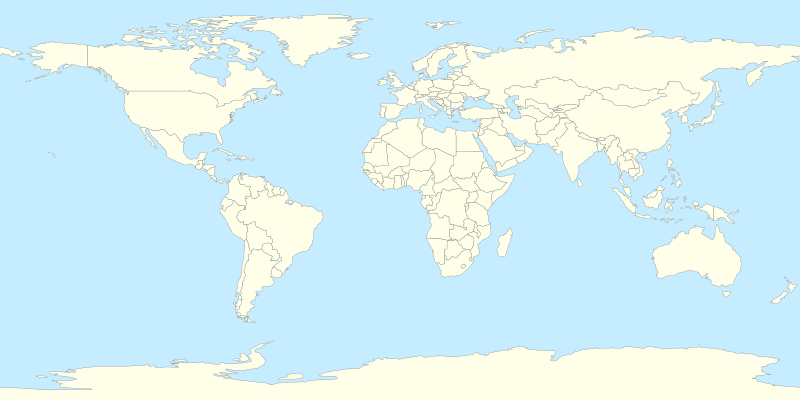
ChinaMarker uses stored geographic coordinates on equirectangular location-map bounds. India map bases: Wikimedia Commons / Uwe Dedering (CC BY-SA 3.0). World political base: public domain; physical world base: Gundan (CC BY-SA 4.0).
📌 Why in News?
An analysis published in August 2026 highlights the mechanics of Beijing's technology and innovation ecosystem. Beijing has constructed a unique market-state hybrid model that systematically integrates top research universities, early-stage start-ups, state-backed capital, and market mechanisms. The initiative focuses specifically on accelerating technology commercialization, expanding physical infrastructure, and building specialized industrial clusters, with an intense strategic priority on Artificial Intelligence (AI) and advanced robotics as central drivers of future economic growth and industrial competitiveness.
Syllabus & Relevance
Prelims: General Science and Current Events of International Importance.
GS-3: Science and Technology- developments and their applications and effects in everyday life; Indigenization of technology and developing new technology; Infrastructure; Industrial growth and technology transfer.
Why it matters for India
Understanding China's hybrid innovation model offers key insights for India's strategic technology ecosystem, including initiatives like Anusandhan National Research Foundation (ANRF), Make in India, and the IndiaAI Mission.
As India seeks to bridge the gap between academic research and commercial technology deployment, analyzing state-led capital deployment and deep-tech industrial clusters in Beijing provides benchmarks for developing India's own domestic AI, robotics, and deep-tech capabilities.
Static Foundation
The innovation ecosystem model relies on the synergistic combination of Triple Helix dynamics (Academia, Industry, and Government) augmented by capital market mechanisms.
In state-capitalist framework, the government performs a dual function: providing foundational physical infrastructure and patient risk capital, while leveraging private market competition to scale innovations.
Academic institutions focus on basic and applied research, which is then translated into market-ready applications through dedicated incubators, specialized tech commercialization offices, and integrated industrial clusters.
Data, Reports, Cases & Examples
Primary Focus Areas: Artificial Intelligence (AI) and advanced robotics designated as core priority domains.
Structural Components: Integrated framework linking research universities, technology start-ups, state capital, and commercial markets.
State Role: Dual facilitation through physical infrastructure development and direct risk capital allocation.
Key Mechanisms: Industrial cluster formation and dedicated technology commercialization pathways.
Prelims Quick Facts
Hybrid Model Definition: Combines state-directed planning and capital with private market enterprise dynamics.
Key Actors: Research universities, deep-tech start-ups, government entities, and private commercial enterprises.
Primary Priority Sectors: Artificial Intelligence (AI) and advanced robotics systems.
State Role: Operates simultaneously as infrastructure provider, primary venture funding catalyst, and regulatory facilitator.
Commercialization Pipeline: Converts academic research into scalable market products through dedicated industrial clusters.
Cluster Strategy: Geographically concentrates talent, research facilities, and funding to lower transaction costs.
Capital Mechanism: Uses state-backed guidance funds to crowd in market capital for early-stage commercialization risks.
Global Significance: Serves as an alternative model to Western pure-market venture capital innovation models.
Mains-only layer✍️ Open Mains Perspective & Answer FrameworkClick to expand ↓
Mains Perspective
Background
Beijing's technology innovation ecosystem represents a distinct market-state hybrid framework developed to maintain competitive leadership in critical emerging technologies. Unlike purely market-driven innovation models that rely almost exclusively on private venture capital, Beijing's model uses direct state intervention to fund infrastructure, lower research costs, and de-risk early-stage deep-tech ventures while leveraging competitive market dynamics for deployment.
Significance
- Accelerated Commercialization: Facilitates swift transition of laboratory discoveries from universities to market applications.
- Targeted Industrial Clusters: Builds concentrated geographical hubs bringing together talent, universities, start-ups, and funding.
- Strategic Tech Leadership: Directs national effort toward critical future growth drivers like Artificial Intelligence and robotics.
- State De-risking: Provides long-term patient capital where private funding might hesitate due to high risk or long payback periods.
India-specific Implications
- Policy Inspiration: Offers lessons for operationalizing India's Anusandhan National Research Foundation (ANRF) to bridge academia-industry divides.
- Deep-Tech Funding: Emphasizes the need for state-backed risk funds to support early-stage hardware, robotics, and deep-tech start-ups in India.
- Cluster Development: Highlight the value of integrated tech corridors combining institutions like IITs, start-up incubators, and industrial parks.
Challenges and Criticisms
- State Overreach Risk: Heavy state involvement can lead to misallocation of capital and political interference in research directions.
- Geopolitical Vulnerabilities: High concentration of strategic technology capabilities invites international scrutiny, trade restrictions, and tech decoupling.
- Market Distortions: Government subsidies may sustain unviable start-ups or create overcapacity in favored sectors.
Way Forward
- Balanced Ecosystem: Combine state-directed foundational R&D funding with transparent market-driven evaluation mechanisms.
- Strengthening Commercialization: Create streamlined technology transfer offices within universities to commercialize indigenous IP.
- Fostering Talent & Clusters: Develop specialized innovation districts linking premier academic centers with venture capital and manufacturing bases.
Answer Framework
Introduction
Define the Beijing market-state hybrid innovation model as an integrated ecosystem combining academic research, start-ups, state risk-capital, and market mechanisms, highlighting its focus on AI and robotics.
Body Dimensions
-
Core Mechanisms: Dual state role (infrastructure supplier and catalyst capital) combined with market competition and industrial cluster synergy.
-
Strategic Priority Areas: AI, robotics, and commercialization pathways bridging basic research and market application.
-
Comparative Relevance for India: Lessons for ANRF, Deep Tech Startup Policy, and academic-industry linkages.
-
Inherent Challenges: Potential capital misallocation, market distortions, and foreign tech friction.
Conclusion
Conclude with the need for a calibrated innovation ecosystem where the state de-risks foundational technologies while enabling private-sector agility and global competitiveness.
Possible Mains Question
Examine the salient features of the market-state hybrid model of technological innovation. How can India draw lessons from such models to strengthen its indigenous deep-tech ecosystem and bridge the gap between academic research and market commercialization?