Map focus
22.80°, 79.00° · maps only where geography mattersIndia
CountryIndia
India locator
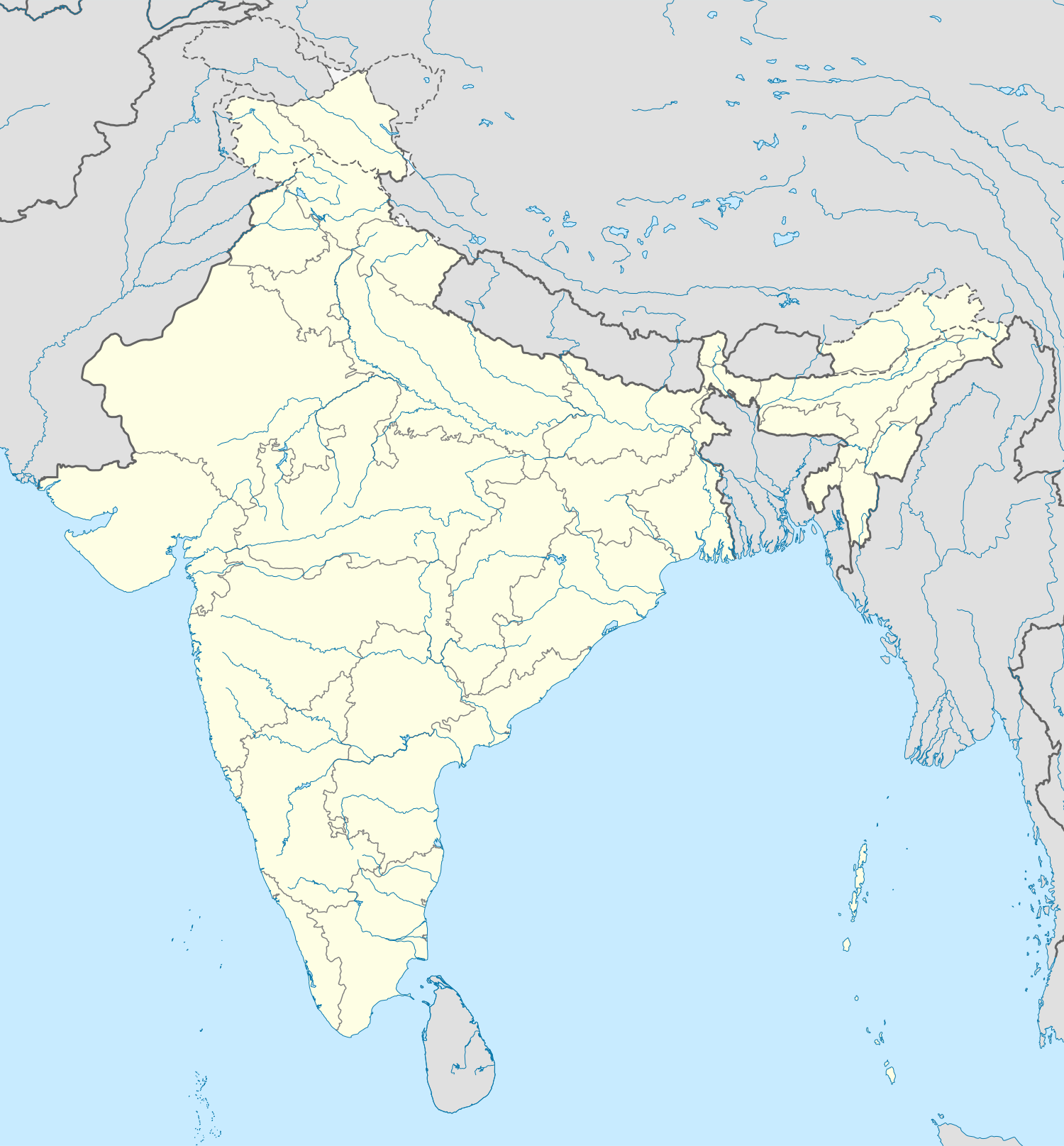 India
India📌 Why in News?
ONGC's ₹1 Trillion Deepwater Push: 87 Wells, Strategic Petroleum Reserve and India's Energy Security Why in News?
- Oil and Natural Gas Corporation plans to invest about ₹1 trillion, roughly US$10.5 billion, over five years in deepwater and ultra-deepwater oil and gas exploration.
- ONGC aims to drill 87 wells by March 2031 as it attempts to reverse the long-term decline in India's domestic oil and gas production.
- The company also plans about ₹70 billion of investment in a strategic petroleum reserve at Mangalore with capacity of 1.75 million tonnes, linking upstream exploration with emergency energy-security infrastructure. Numbers That Define the Story
- Deepwater exploration plan: ₹1 trillion over five years.
- Planned drilling: 87 wells by March 2031.
- Proposed Mangalore strategic reserve investment: around ₹70 billion.
- Proposed Mangalore storage capacity: 1.75 million tonnes.
- Planned global trading unit: Dubai or Singapore by March 2027.
- Potential trading volume of the proposed unit: up to 50 million tonnes of crude oil, refined products and gas annually.
- India imports roughly 85% of its crude-oil needs, which makes domestic production and emergency reserves strategically important. Deepwater and Ultra-Deepwater
- Static Foundation
- Offshore exploration occurs beneath the seabed. Deepwater projects involve much greater water depth, pressure, engineering complexity and cost than shallow-water operations.
- Ultra-deepwater projects require specialised rigs, subsea production systems, high-pressure equipment and advanced seismic imaging.
- High geological uncertainty means exploration wells may fail even after large expenditure; this makes fiscal terms and risk-sharing important in upstream policy.
- Technological advances in seismic processing, drilling and subsea engineering can make previously uneconomic resources commercially viable. Why 87 Wells Matter
- Exploration intensity is a key determinant of reserve discovery. Drilling 87 wells by March 2031 represents a large multi-year attempt to expand the resource base.
- More wells do not guarantee commercial discoveries because geology remains uncertain, but insufficient drilling almost certainly limits discovery.
- Successful discoveries can take years to move from appraisal to development and production, so today's exploration affects medium-term energy supply rather than tomorrow's petrol price.
- India therefore needs continuity in upstream investment even during periods of volatile global crude prices. ONGC's Role
- ONGC is India's largest state-owned upstream oil and gas producer and plays a central role in domestic exploration.
- As a public-sector enterprise, ONGC has both commercial objectives and strategic significance because domestic production reduces marginal exposure to imported energy.
- Upstream production supports refineries, petrochemicals, fertiliser and city-gas value chains.
- Corporate investment decisions still require commercial discipline because public ownership does not eliminate geological or financial risk. Strategic Petroleum Reserve
- Concept
- A Strategic Petroleum Reserve, or SPR, is emergency crude storage designed to cushion supply disruptions; it is not the same as routine commercial inventory held by oil companies.
- India's reserve strategy is particularly relevant because crude import dependence is roughly 85%.
- The proposed Mangalore expansion of 1.75 million tonnes would add physical buffering capacity against war, shipping disruption or sudden global supply shock.
- SPR effectiveness depends not only on storage volume but also on release rules, refinery connectivity, crude compatibility and replenishment strategy. Mangalore
- Location Relevance
- Mangalore lies on India's western coast in Karnataka and is connected to major petroleum infrastructure.
- Western-coast storage is strategically useful because a large share of imported crude reaches India through Arabian Sea routes.
- The Strait of Hormuz is a major global oil chokepoint; disruption there can affect Indian import costs and availability.
- Location-based UPSC linkage: Mangalore faces the Arabian Sea, not the Bay of Bengal. Oil Import Dependence
- At roughly 85% crude import dependence, India is exposed to global price shocks, geopolitical conflict, shipping insurance costs and currency movements.
- A **US$10 **rise in crude prices can materially affect the import bill and inflation trajectory even if domestic consumption remains unchanged.
- Domestic production does not need to eliminate imports to improve resilience; every additional barrel produced at home reduces marginal exposure.
- Energy security therefore combines affordability, availability, accessibility and acceptability rather than self-sufficiency alone. Exploration vs Production
- Exploration identifies hydrocarbon prospects; appraisal determines size and commercial viability; development builds wells and facilities; production extracts the resource.
- UPSC answers should not treat an announced exploration budget as immediate additional oil output.
- The 87-well plan represents exploration and drilling activity whose successful discoveries may feed later production.
- Long lead times make upstream policy sensitive to regulatory certainty and stable contractual terms. Trading Unit
- Strategic Significance
- ONGC plans to establish a trading unit in Dubai or Singapore by March 2027 through a joint venture with a global partner.
- The proposed unit could handle up to 50 million tonnes of crude, refined products and gas annually, including internal and third-party volumes.
- A global trading desk can improve price discovery, cargo optimisation, hedging and access to multiple markets.
- However, commodity trading introduces market, credit and operational risk and therefore requires strong governance and risk limits. Energy Security and the Current Account
- Crude oil is one of India's largest merchandise import items, so high prices widen the import bill and can pressure the current account deficit.
- Because crude is priced in dollars, rupee depreciation raises the domestic cost of the same dollar-denominated barrel.
- Higher energy costs can transmit into transport, fertiliser, petrochemicals and inflation.
- Domestic production and SPRs reduce different risks: production lowers recurring import dependence, while SPRs provide emergency insurance against temporary supply disruption. Natural Gas Dimension
- Deepwater basins may contain both crude oil and natural gas. Gas can support fertiliser, city gas, industry and power where commercially viable.
- Natural gas generally emits less carbon dioxide per unit of energy than coal, though methane leakage can erode some climate benefits.
- India's transition therefore requires both near-term gas-system efficiency and long-term expansion of low-carbon energy.
- Exploration policy must be compatible with environmental safeguards, coastal regulation and marine ecosystem protection. Environmental and Safety Concerns
- Deepwater drilling carries spill, blowout and marine-ecosystem risks, with emergency response more difficult far offshore.
- Environmental impact assessment, well-control standards, spill-response planning and liability frameworks are essential.
- Climate policy also creates a long-term stranded-asset risk if high-cost fossil investments become uneconomic during the energy transition.
- Energy security must therefore balance present import dependence with India's long-term decarbonisation commitments. Strategic Petroleum Reserves
- Governance Questions
- Emergency stocks need transparent trigger conditions: physical shortage, severe price shock or strategic disruption may require different responses.
- Releasing reserves too early can leave the country exposed if a crisis lasts longer than expected.
- Replenishing stocks when prices fall can improve fiscal efficiency.
- Commercial leasing of part of storage capacity may improve utilisation, but strategic availability during emergencies must remain protected. Way Forward
- Accelerate exploration in under-explored basins while maintaining transparent fiscal and regulatory conditions.
- Connect the 1.75 million-tonne Mangalore reserve to a broader national SPR strategy with robust pipeline and refinery access.
- Use advanced seismic imaging, subsea technology and data analytics to improve the probability of commercial discoveries from the 87-well programme.
- Diversify crude suppliers and shipping routes while expanding renewables, storage, biofuels and electric mobility.
- Treat domestic exploration, strategic reserves and energy transition as complementary layers of energy security rather than competing policies. Prelims Quick Revision
- ONGC plan: ₹1 trillion over five years for deepwater and ultra-deepwater exploration.
- Planned wells: 87 by March 2031.
- Mangalore SPR proposal: about ₹70 billion investment and 1.75 million tonnes capacity.
- Planned trading unit: Dubai or Singapore by March 2027; up to 50 million tonnes annual trading volume.
- India imports roughly 85% of its crude-oil requirement.
- SPR = emergency strategic storage; it is distinct from ordinary commercial inventory. Probable Prelims Question Consider the following statements: Strategic petroleum reserves are designed primarily for emergency supply security; deepwater exploration can immediately be treated as proven production; and Mangalore lies on India's Arabian Sea coast. Which statements are correct? Probable Mains Question India's energy security requires more than buying crude from diverse suppliers. Analyse the role of domestic deepwater exploration, strategic petroleum reserves and trading capability in reducing external vulnerability.
🎯
Exam map
Syllabus & Relevance
Paper: GS Paper II, GS Paper III
Theme: Economy and Energy Security
🎯
Rapid revision
Prelims Quick Facts
Prelims facts will be updated soon.