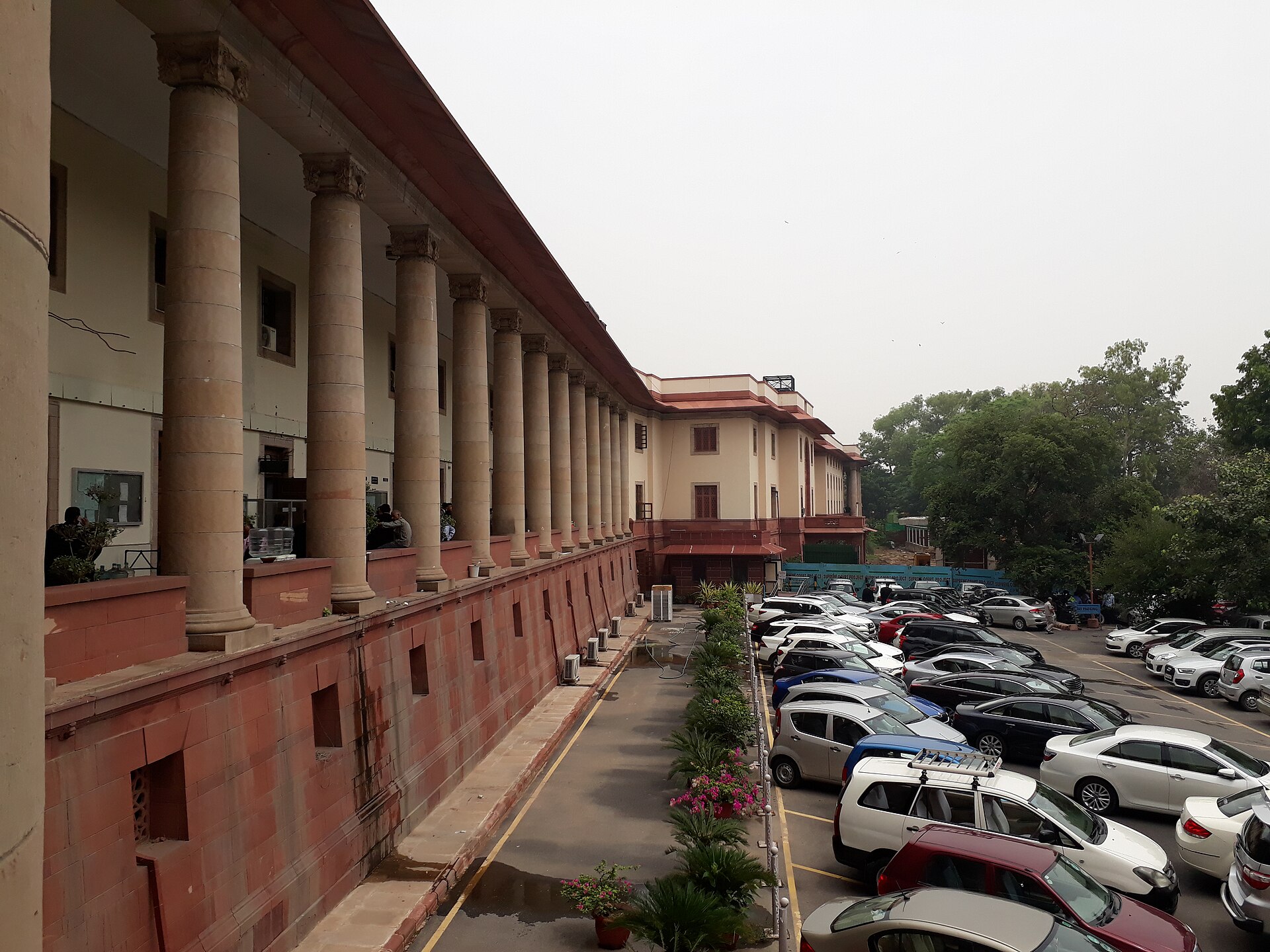
Locate the place
 India
India India
IndiaMarker uses stored geographic coordinates on equirectangular location-map bounds. India map bases: Wikimedia Commons / Uwe Dedering (CC BY-SA 3.0). World political base: public domain; physical world base: Gundan (CC BY-SA 4.0).
📌 Why in News?
The Supreme Court recently clarified that State governments remain fully empowered to close or withdraw First Information Reports (FIRs) registered against student protesters during mass agitations, provided they strictly follow the statutory procedures prescribed under the Bharatiya Nagarik Suraksha Sanhita (BNSS). This clarification reinforces the rule of law by confirming that while governments can initiate the withdrawal of cases, such actions cannot occur via arbitrary executive cancellation and must instead navigate established judicial and statutory channels.
Syllabus & Relevance
Prelims Domain: Indian Polity and Governance, Criminal Justice System.
GS Paper II: Structure, organization and functioning of the Executive and the Judiciary; Statutory, regulatory and various quasi-judicial bodies.
Current-Static Link: Statutory procedures under the BNSS governing the closure and withdrawal of criminal proceedings vis-a-vis judicial oversight.
Why it matters for India
Crucial for India's criminal justice system, maintaining the balance between executive policy decisions regarding mass agitations, student protests, and independent judicial oversight.
It safeguards citizens from arbitrary executive interference while ensuring proper recourse for victims and preventing the unnecessary burdening of individuals with lasting criminal records for minor protests.
Static Foundation
Definition of FIR: First written information recorded by the police regarding a cognizable offence.
Primary Trigger: Empowers police authorities to investigate a cognizable offence without requiring a prior court warrant.
Lack of Executive Cancellation: An FIR cannot be unilaterally cancelled, revoked, or expunged through an executive order or ministerial directive.
Judicial Oversight: Once an FIR is registered, any termination or resolution requires formal police filings or explicit judicial approval.
Nature of Evidence: Functions strictly as an initial report and does not constitute substantive or conclusive evidence until corroborated during trial.
Data, Reports, Cases & Examples
Section 193 of the BNSS: Empowers the investigating agency to submit a **Closure Report **or **Final Report **to the jurisdictional Magistrate if evidence is insufficient.
Palaniswamy Veeraraja v. State of Karnataka (2026): Affirms the Magistrate's full supervisory authority to accept, reject, order further investigation, or take independent cognizance of a police closure report.
Section 360 of the BNSS: Enables the Public Prosecutor or Assistant Public Prosecutor to apply to the trial court for withdrawing from prosecution before judgment.
Sheonandan Paswan v. State of Bihar (1986): Established that a prosecutor's withdrawal application must stem from independent judgment, require explicit court consent in good faith/public interest, and mandate victim hearing opportunities.
Section 528 of the BNSS: Grants High Courts inherent powers to quash an FIR or chargesheet to prevent process abuse or secure justice.
Prelims Quick Facts
Definition: An FIR is the foundational document that sets the official criminal investigation process into motion for a cognizable offence.
Executive Power Limitation: An FIR cannot be unilaterally cancelled or expunged by an executive order passed by a government or minister.
Section 193 BNSS: Governs the submission of a Closure Report by police when evidence is insufficient.
Magistrate Authority: Under Section 193 BNSS, the Magistrate holds full supervisory authority, including the power to order further investigation or take cognizance independently (Palaniswamy Veeraraja v. State of Karnataka, 2026).
Section 360 BNSS: Allows a Public Prosecutor or Assistant Public Prosecutor to seek withdrawal from prosecution prior to judgment.
Prosecutorial Independence: Withdrawal under Section 360 BNSS must reflect the prosecutor's independent judgment rather than mere executive dictation.
Section 528 BNSS: Empowers High Courts with inherent powers to quash FIRs or pending chargesheets to prevent court process abuse.
Prelims Trap: An executive government order can automatically quash or cancel a registered FIR without judicial or police intervention. (False: FIRs cannot be unilaterally cancelled by executive order; proper statutory routes like BNSS procedures must be followed).
Mains-only layer✍️ Open Mains Perspective & Answer FrameworkClick to expand ↓
Mains Perspective
Background
The registration of a First Information Report (FIR) initiates the formal criminal investigation process under the Bharatiya Nagarik Suraksha Sanhita (BNSS). Historically and legally, an FIR once registered possesses public character, meaning it cannot be erased or cancelled by a simple executive fiat or ministerial decree. Recent Supreme Court clarifications regarding student protesters in mass agitations have brought focus back to how these legal instruments are closed or withdrawn through established statutory mechanisms.
Significance
The requirement to follow formal statutory routes ensures that the criminal justice system remains transparent and accountable. Allowing minor cases against student protesters or agitators to be withdrawn through proper legal channels helps restore social peace and prevents individuals from carrying lasting criminal stigmas for non-heinous acts.
India-specific Implications
In a democratic polity with frequent public agitations and student protests, the administration frequently faces the dilemma of withdrawing mass cases. The legal framework ensures that while states possess the policy space to drop minor charges, this power is checked by mandatory judicial oversight to protect public interest, systemic integrity, and the rule of law.
Challenges and Criticisms
A major challenge lies in balancing executive policy discretion with judicial independence. Arbitrary executive dictation pushing for wholesale withdrawal of cases can undermine the rule of law if prosecutors act merely as agents of the government rather than independent officers of the court. Furthermore, ensuring that victims are adequately heard before withdrawal adds procedural complexity.
Way Forward
State governments and prosecuting agencies must strictly adhere to statutory provisions under Sections 193, 360, and 528 of the BNSS. Prosecutors must exercise genuine independent judgment, courts must rigorously verify good faith and public interest, and victims' rights to be heard must be strictly honored to preserve trust in the criminal justice architecture.
Answer Framework
Introduction: Define an FIR as the primary trigger for cognizable investigations under the BNSS and state the principle that it cannot be cancelled by executive fiat.
Body Dimensions: Detail the three statutory pathways for closure—Police **Closure Report **under Section 193 (with Magistrate oversight per Palaniswamy Veeraraja v. State of Karnataka, 2026), Withdrawal from Prosecution under Section 360 (requiring independent prosecutorial judgment, public interest, and victim hearing per Sheonandan Paswan v. State of Bihar, 1986), and High Court Quashing under Section 528. Discuss significance regarding student protesters and prevention of arbitrary executive actions
Conclusion
Summarize that upholding statutory procedures ensures a balance between state policy flexibility in mass agitations and robust judicial protection of citizens' rights and the rule of law.
Possible Mains Question
Examine the statutory mechanisms available under the Bharatiya Nagarik Suraksha Sanhita (BNSS) for withdrawing or closing FIRs. How do these provisions balance state policy considerations with judicial oversight and victims' rights?