Map focus
22.80°, 79.00° · maps only where geography mattersIndia
CountryIndia
India locator
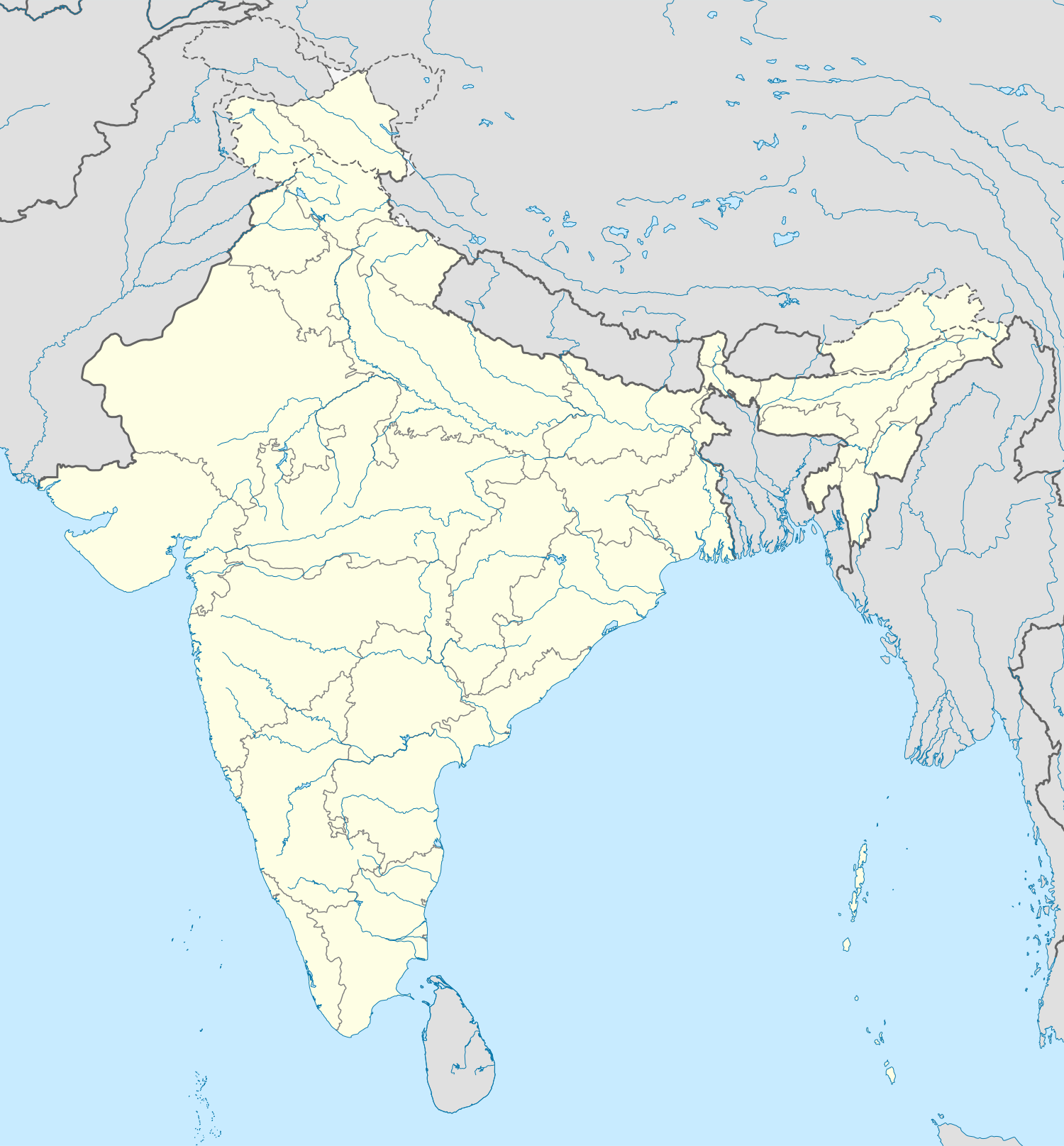 India
India📌 Why in News?
Share CA_CATEGORY: Agriculture, Bihar and Exports CA_GS: GS Paper III CA_DATE: 31 August 2026 CA_IMAGE: NO India's Makhana Economy: 80,590 MT Output, ₹192.96 Crore Exports and Bihar's 80-85% Global Supply Share Why in News?
- India is the world's largest producer of makhana, and Bihar contributes nearly three-fourths of national production while accounting for about 80-85% of global supply.
- India's makhana production was 63,910 MT in 2024-25 with average productivity of 2.03 MT per hectare; the 2025-26 second advance estimate rose to 80,590 MT with productivity of 2.34 MT per hectare.
- Bihar alone produced about 60,000 MT in 2025-26 with average productivity around 2.00 MT per hectare. Exports and Value Addition
- India exported 7,264.89 MT of makhana products in 2025-26 with export value of ₹19,296.08 lakh, or about ₹192.96 crore.
- The difference between raw output and export volume shows that the domestic market remains important and that value addition can raise earnings without exporting the majority of production.
- Roasting, flavouring, grading, packaging and branding convert a traditional aquatic seed into a premium snack product.
- Export growth requires food-safety standards, moisture control, traceability and consistent quality. National Makhana Board
- The National Makhana Board was announced in Union Budget 2025-26 and formally launched in Bihar on 15 September 2025.
- The Board is intended to strengthen production, processing, marketing, research and farmer support across the value chain.
- A dedicated commodity institution can coordinate research, seed quality, mechanisation, FPOs and export promotion.
- Governance success should be measured through farmer price realisation and productivity, not only branding. ₹476.03 Crore Central Sector Scheme
- The Central **Sector Scheme **for Development of Makhana has an outlay of ₹476.03 crore for 2025-26 to 2030-31.
- ₹30 crore was approved for 2025-26 and ₹90 crore for 2026-27.
- The scheme supports research, quality seed, farmer skills, harvesting, post-harvest systems, value addition, branding, exports and quality control.
- Because it is a Central Sector Scheme, funding architecture differs from Centrally Sponsored Schemes that involve State cost sharing. Geography of Makhana
- Makhana, Euryale ferox, is an aquatic crop grown in ponds, wetlands and shallow water systems.
- Production is concentrated in North Bihar, especially the Kosi basin districts of Supaul, Saharsa and Madhepura and adjoining Mithila and Seemanchal regions.
- Wetland ecology, water depth and labour-intensive harvesting shape the production system.
- Climate and hydrological changes in floodplain landscapes can therefore directly affect makhana livelihoods. GI and Branding
- Mithila Makhana has Geographical Indication recognition, linking product reputation with geographic origin.
- GI can help prevent misuse of a regional name and support premium branding, but registration alone does not guarantee higher farmer income.
- Traceability, collective marketing and quality standards are required to translate GI recognition into market power.
- FPOs can aggregate small producers and negotiate better with processors and retailers. Productivity Story
- National average productivity rose from 2.03 MT/ha in 2024-25 to an estimated 2.34 MT/ha in 2025-26.
- Productivity improvement reduces pressure to expand into ecologically sensitive wetlands merely to raise output.
- Research on improved varieties, nursery systems and mechanised popping can reduce labour intensity.
- Technology must remain accessible to small cultivators so value-chain modernisation does not concentrate gains among processors. Nutrition and Market Demand
- Makhana is marketed as a low-fat snack and is used in traditional diets, fasting foods and value-added products.
- Health-conscious urban demand has increased domestic prices and encouraged startups to enter flavoured and packaged segments.
- Premiumisation creates opportunities but also exposes farmers to demand cycles and quality standards.
- Market intelligence can help FPOs decide between raw sale, processing and contract supply. Bihar Development Link
- With about 60,000 MT production in 2025-26 and 80-85% of global supply linked to Bihar, makhana is a natural candidate for district-level agro-processing clusters.
- Processing close to production can retain more value and employment in North Bihar.
- Cold chains are less central than for perishables, but drying, grading, storage and moisture management are critical.
- Road, rail, testing laboratories and export facilitation can turn a regional crop into a durable rural-industry ecosystem. Way Forward
- Use the ₹476.03 crore scheme to improve seed, mechanisation and farmer-level processing.
- Create transparent price and export dashboards for the 80,590 MT national production base.
- Strengthen GI traceability and **FPO-**led branding.
- Protect wetlands and water quality while improving productivity on existing cultivated systems.
- Build Bihar-based processing clusters so a larger share of the ₹192.96 crore export value and growing domestic market reaches producers. Prelims Quick Revision
- Scientific name: Euryale ferox.
- India production: 63,910 MT in 2024-25 → estimated 80,590 MT in 2025-26.
- Bihar: ~60,000 MT in 2025-26; about 80-85% of global supply.
- Exports 2025-26: 7,264.89 MT; ₹19,296.08 lakh (~₹192.96 crore).
- Central Sector Scheme: ₹476.03 crore, 2025-26 to 2030-31.
- National Makhana Board launched in Bihar on 15 September 2025. Probable Mains Question Makhana demonstrates how a geographically concentrated traditional crop can become a global value chain. Discuss the opportunities and ecological challenges with special reference to Bihar.
🎯
Exam map
Syllabus & Relevance
Paper: GS-3
Theme: Economy
🎯
Rapid revision
Prelims Quick Facts
Prelims facts will be updated soon.