Map focus
22.80°, 79.00° · maps only where geography mattersIndia
CountryIndia
India locator
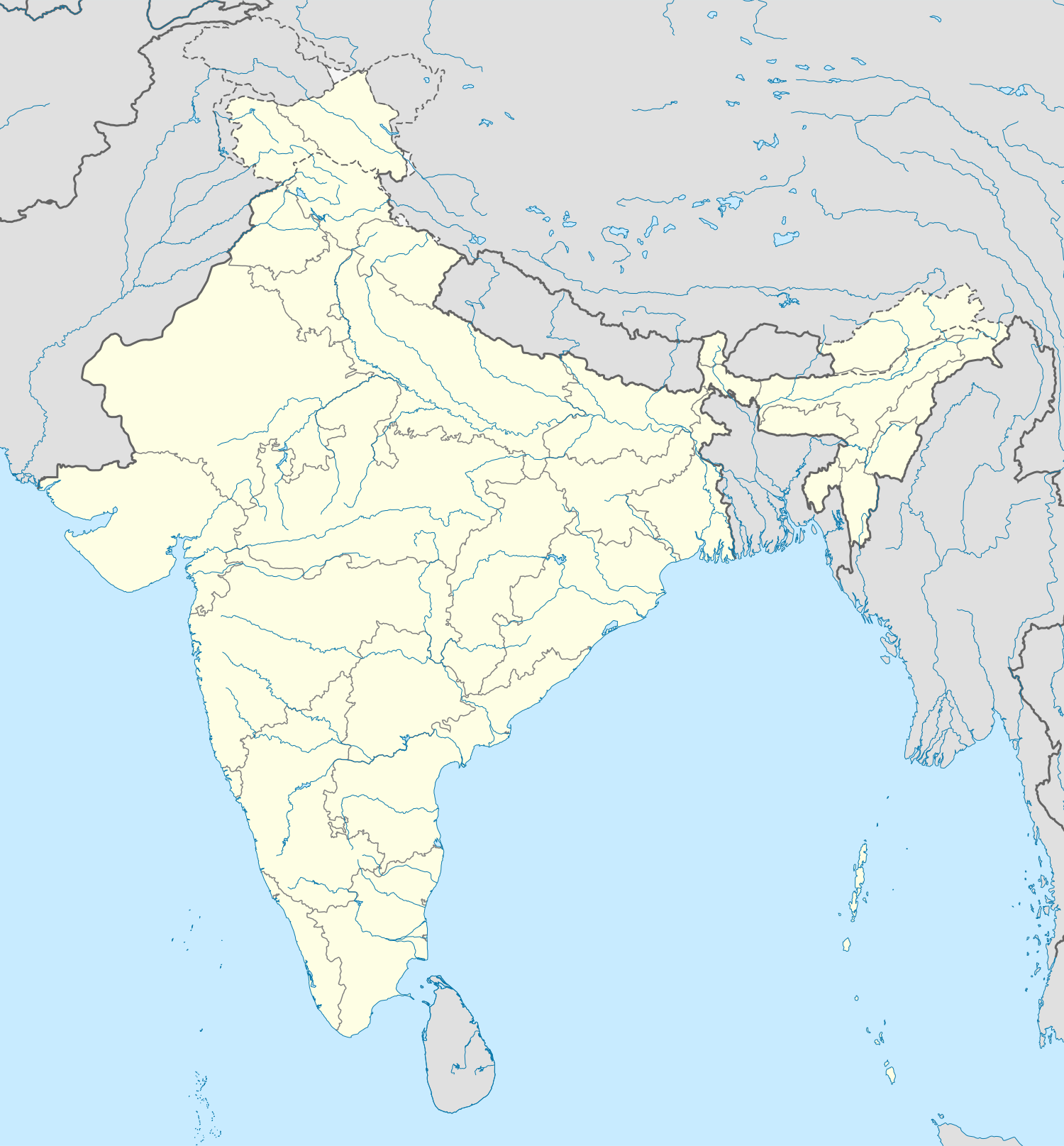 India
India📌 Why in News?
Per Drop More Crop: 115 Lakh Hectares under Micro-Irrigation and India's Water-Use Efficiency Challenge Why in News?
- Per Drop More Crop has brought more than 115 lakh hectares under micro-irrigation as of July 2026, placing water-use efficiency at the centre of agricultural policy.
- Agriculture uses more than 80% of India's available water resources, while only about 50% of net sown area has irrigation facilities; the combination of high water use and incomplete irrigation coverage makes efficiency as important as creating new water supply.
- PDMC is currently implemented under Pradhan Mantri Rashtriya Krishi Vikas Yojana; it was a component of PMKSY from 2015-16 to 2021-22. Micro-Irrigation: Data in Practice
- NITI Aayog's 2020-21 review reported farmer-income gains of 10-69% and water-use-efficiency improvements of 30-70% under micro-irrigation.
- Economic Survey 2020-21 reported water savings of 20-48%, energy savings of 10-17%, labour-cost reductions of 30-40%, fertiliser savings of 11-19% and crop-yield gains of 20-38%.
- Financial assistance is available for up to 5 hectares per beneficiary: 55% assistance for small and marginal farmers and 45% for other farmers.
- These figures show that micro-irrigation affects the water-energy-fertiliser nexus simultaneously, rather than being only an irrigation technology. Drip and Sprinkler Systems
- Drip irrigation delivers water near the root zone through emitters, reducing evaporation and conveyance losses; in-line systems suit regularly spaced crops while on-line emitters can suit uneven plant spacing.
- Sprinkler systems distribute pressurised water through nozzles and are useful for many field crops, pulses, spices and situations where land levelling is difficult.
- Fertigation applies soluble fertilisers through irrigation water; combining precise water and nutrients can reduce the 11-19% fertiliser losses reported in micro-irrigation assessments.
- Efficiency gains depend on design, pressure, filtration and maintenance; clogged emitters or poorly designed systems can erase theoretical savings. Groundwater and Energy Link
- Groundwater irrigation links farm water use with electricity demand because millions of pumps lift water from aquifers.
- Micro-irrigation's reported 10-17% energy savings can reduce both farmer costs and the fiscal burden where agricultural electricity is subsidised.
- In over-exploited aquifers, however, efficiency can create a rebound effect if saved water is used to expand irrigated area; water accounting and crop planning remain necessary.
- Solar pumps need similar safeguards: zero marginal electricity cost can encourage excessive pumping unless paired with groundwater governance. Climate Resilience
- Heat waves and erratic rainfall increase crop water stress, making controlled irrigation more valuable during critical growth stages.
- Micro-irrigation cannot create water where aquifers and reservoirs are depleted; it must be combined with watershed development, rainwater harvesting and aquifer recharge.
- With nearly half of net sown area lacking irrigation facilities, rainfed agriculture remains highly exposed to monsoon variability.
- Precision irrigation is therefore an adaptation tool, but climate resilience also requires crop diversification and drought-tolerant varieties. Crop Choice and Virtual Water
- Water-intensive crops in water-stressed regions can undermine gains from efficient irrigation.
- Virtual water refers to water embedded in producing traded goods; exporting water-intensive crops from stressed basins can indirectly export scarce water.
- Policy should combine micro-irrigation incentives with agro-climatic crop planning and realistic signals about groundwater scarcity.
- Millets, pulses and oilseeds can have lower water requirements than paddy or sugarcane in many agro-ecological settings, though crop suitability is location-specific. Governance and DBT
- PDMC uses digital implementation and Direct Benefit Transfer to improve transparency in assistance for irrigation equipment.
- DBT reduces intermediary layers but accurate land, bank and beneficiary records remain necessary to prevent exclusion.
- State implementation capacity determines vendor quality, installation verification and after-sales maintenance.
- Outcome monitoring should measure actual water saved and yield gained, not only hectares covered. Way Forward
- Move from hectare-based targets to basin-level water productivity measured as output or income per unit of water.
- Prioritise the most water-stressed blocks and high-value crops where the 30-70% efficiency gains can produce maximum benefit.
- Combine PDMC with Soil Health Cards, weather advisories, groundwater monitoring and crop diversification.
- Create repair and maintenance ecosystems so installed systems remain functional beyond the subsidy period. Prelims Quick Revision
- PDMC coverage: over 115 lakh hectares by July 2026.
- Agriculture uses over 80% of available water resources; only about 50% of net sown area has irrigation facilities.
- Assistance: 55% for small/marginal farmers, 45% for others, up to 5 hectares.
- NITI review: 30-70% water-use-efficiency improvement and 10-69% income gains.
- Economic Survey: 20-48% water savings and 20-38% crop-yield gains. Probable Mains Question Micro-irrigation can address India's water-energy-fertiliser nexus, but technology alone cannot solve agricultural water stress. Examine with data from Per Drop More Crop.
🎯
Exam map
Syllabus & Relevance
Paper: GS Paper II, GS Paper III
Theme: Agriculture and Water Resources
🎯
Rapid revision
Prelims Quick Facts
Prelims facts will be updated soon.