Map focus
22.80°, 79.00° · maps only where geography mattersIndia
CountryIndia
India locator
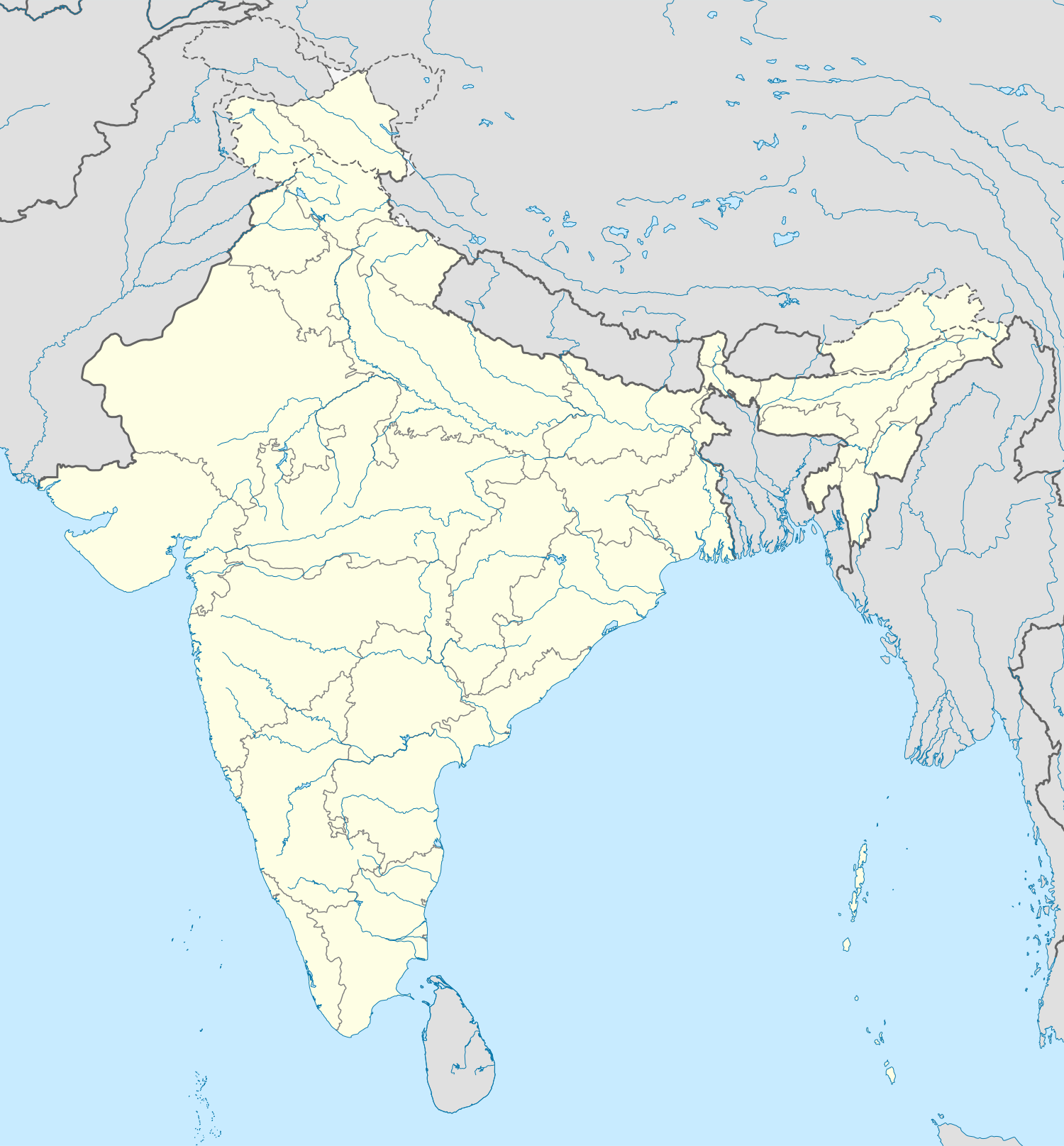 India
India📌 Why in News?
Protection and Regulatory Sovereignty CA_CATEGORY: International Relations and Economy CA_GS: GS Paper II, GS Paper III CA_DATE: 31 August 2026 CA_IMAGE: NO Qualified Most-Favoured Nation Clause in India's Investment Treaties: Balancing Investor Protection and Regulatory Sovereignty Why in News?
- India is reportedly considering a limited or qualified form of the Most-Favoured Nation provision while reviewing its bilateral investment treaty framework.
- The debate is significant because India excluded the MFN clause from its 2016 Model Bilateral Investment Treaty after adverse experiences with investor-state arbitration.
- A carefully qualified MFN clause could support reciprocal investor protection while attempting to preserve India's regulatory and policy space. What is a Bilateral Investment Treaty?
- A Bilateral Investment Treaty, or BIT, is an agreement between two countries that establishes standards for treatment and protection of investors and investments from the partner country.
- BITs commonly deal with issues such as fair treatment, protection against unlawful expropriation, transfer of funds and mechanisms for settlement of investment disputes.
- The purpose is to create predictability for cross-border investment, but treaty obligations can also constrain governments if drafted too broadly.
- BITs concern investment protection and should not be confused with Free Trade Agreements, although some broader economic agreements may contain investment chapters. Most-Favoured Nation in Investment Treaties
- An MFN clause in an investment treaty generally requires a country to give investors of one treaty partner treatment no less favourable than comparable treatment given to investors of another treaty partner.
- The central concern is treaty shopping: an investor may attempt to import more favourable provisions from a different treaty through an expansive interpretation of MFN.
- A qualified MFN clause can restrict the scope of comparison, specify excluded areas and prevent automatic importation of dispute-settlement provisions.
- Such drafting tries to provide non-discrimination without creating unlimited treaty obligations. Investment MFN vs WTO MFN
- MFN in investment law concerns treatment of foreign investors and investments under investment agreements.
- MFN under the World Trade Organization is a foundational non-discrimination principle in trade, requiring advantages given to one WTO member to be extended to other members subject to permitted exceptions.
- The two operate in different legal contexts and should not be treated as identical.
- UPSC may test this distinction because the same phrase Most-Favoured Nation appears in both trade and investment law. India's 2016 Model BIT
- India adopted a revised Model BIT in 2016 after concerns about broad treaty language and international arbitration claims.
- The model placed greater emphasis on the state's right to regulate and adopted a more cautious approach to investor protections.
- India also moved to renegotiate or replace several older investment treaties based on the revised approach.
- The 2016 framework reflected the policy objective of balancing investment promotion with regulatory sovereignty. Investor-State Dispute Settlement
- Investor-State Dispute Settlement, or ISDS, allows eligible foreign investors to bring treaty-based claims against a host state before an international arbitral forum when treaty protections are allegedly violated.
- Supporters argue that ISDS can protect investors from arbitrary state action, particularly where domestic remedies are perceived as weak.
- Critics argue that broadly drafted provisions may expose legitimate public-interest regulation to costly litigation.
- India's policy challenge is therefore not simply to accept or reject arbitration, but to define precise substantive and procedural safeguards. Why India May Reconsider a Qualified MFN
- Indian companies investing abroad also seek predictable and non-discriminatory treatment in foreign jurisdictions.
- A balanced MFN provision can improve reciprocity and may strengthen India's negotiating position with major economic partners.
- Greater treaty certainty can support long-term investment decisions where projects involve large sunk costs.
- However, the provision must be drafted narrowly enough to prevent unintended expansion of India's treaty commitments. Regulatory Sovereignty
- Regulatory sovereignty means the government's capacity to legislate and regulate in the public interest within constitutional and international-law limits.
- Public health, environmental protection, taxation, financial stability, labour regulation and national security may require policy changes that affect investors.
- Investment treaties therefore need carefully drafted exceptions and clarifications so that legitimate regulation is not automatically treated as treaty violation.
- At the same time, regulatory sovereignty cannot become a justification for arbitrary discrimination or unlawful expropriation. Expropriation
- Direct expropriation occurs when the state formally takes ownership or control of an investment.
- Indirect expropriation refers to state measures that may substantially deprive an investor of the use or economic value of an investment without formal transfer of title.
- Modern treaties often clarify that bona fide, non-discriminatory public-welfare regulation does not ordinarily amount to indirect expropriation.
- The distinction is important for balancing property protection with the state's police and regulatory powers. Foreign Direct Investment and Treaty Certainty
- Investment treaties are only one determinant of Foreign Direct Investment. Market size, macroeconomic stability, infrastructure, rule of law, taxation, skilled labour and ease of doing business are also critical.
- Therefore, stronger treaty protection does not automatically guarantee larger FDI inflows.
- Nevertheless, predictable legal treatment can reduce perceived political and regulatory risk for long-duration investments.
- India's treaty policy should therefore complement, not substitute for, domestic economic and judicial reforms. Strategic Context
- India is simultaneously negotiating trade and investment arrangements with multiple major partners while Indian firms expand globally.
- A modern treaty network can support outward Indian investment as well as inward investment.
- Negotiations also interact with India's goal of becoming a major manufacturing and supply-chain hub.
- The challenge is to avoid both extremes: excessive exposure to litigation and an overly restrictive framework that reduces treaty value for investors. Design of a Qualified MFN Clause
- A qualified clause can expressly exclude dispute-settlement provisions from MFN treatment.
- It can restrict comparisons to investors in like circumstances and preserve sector-specific or treaty-specific exceptions.
- It may exclude advantages arising from customs unions, taxation arrangements or particular regional integration frameworks.
- Clear drafting reduces interpretive uncertainty and can make treaty obligations more predictable for both the state and investors. Way Forward
- India should negotiate treaty provisions based on reciprocity, precise definitions and transparent exceptions.
- Domestic ministries and state governments should receive greater capacity-building on treaty obligations because regulatory actions across levels of government may affect investors.
- India should strengthen dispute prevention through consultation and early resolution mechanisms before disputes escalate to arbitration.
- Periodic review of treaty outcomes should examine investment flows, litigation exposure and the experience of Indian investors abroad. Prelims Quick Revision
- BIT means Bilateral Investment Treaty; it deals with investment protection between treaty partners.
- MFN in an investment treaty is distinct from the WTO's trade-related MFN principle.
- India's revised Model BIT dates to 2016.
- ISDS refers to Investor-State Dispute Settlement.
- A qualified MFN can limit the ability to import broader protections from third-country treaties.
- Treaty design seeks a balance between investor protection and the state's right to regulate. Probable Prelims Question With reference to Most-Favoured Nation treatment, consider the following statements: MFN clauses can appear in both investment treaties and the WTO framework; their legal operation is identical in both contexts; and a qualified investment MFN may exclude dispute-settlement provisions. Which statements are correct? Probable Mains Question India's investment treaty policy must protect Indian and foreign investors without compromising legitimate regulatory autonomy. Examine the case for a qualified Most-Favoured Nation clause in India's evolving BIT framework.
🎯
Exam map
Syllabus & Relevance
Paper: GS-2
Theme: International Relations
🎯
Rapid revision
Prelims Quick Facts
Prelims facts will be updated soon.