Map focus
22.80°, 79.00° · maps only where geography mattersIndia
CountryIndia
India locator
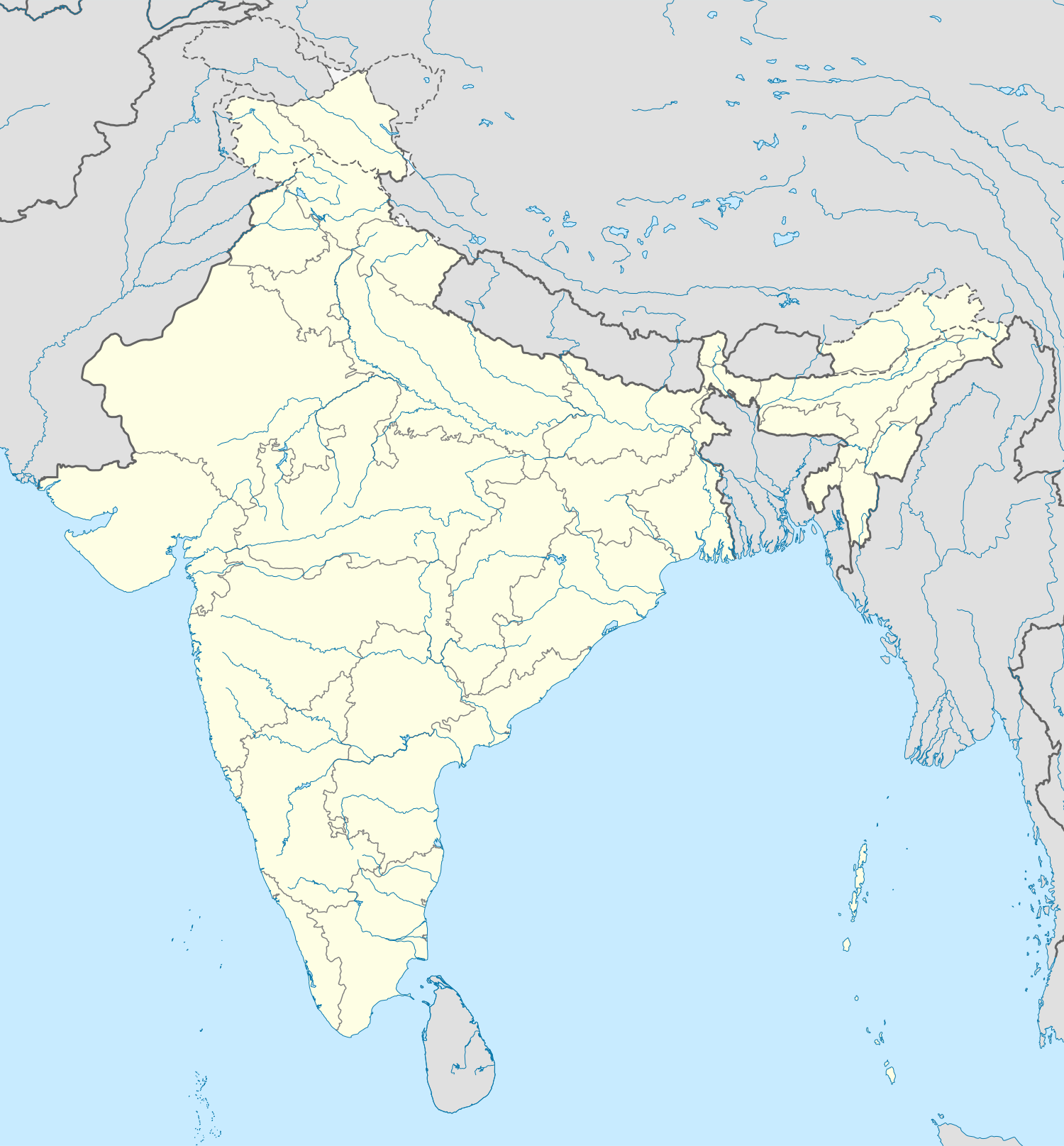 India
India📌 Why in News?
26th SCO Summit at Bishkek: India's Central Asia Strategy and Strategic Autonomy
Why in News?
- Prime Minister Narendra Modi is participating in the 26th Shanghai Cooperation Organisation Summit at Bishkek, Kyrgyz Republic, on 31 August-1 September 2026.
- The summit coincides with the 25th anniversary of the SCO.
- India has been a full SCO member since 2017.
- India's priorities at the summit centre on Security, Connectivity and Opportunity.
- The summit is important because it brings together major Eurasian powers and Central Asian states amid changing global power equations, regional-security concerns, connectivity competition and geopolitical fragmentation.
SCO
- Static Foundation
- The SCO emerged from the earlier Shanghai Five mechanism comprising China, Russia, Kazakhstan, Kyrgyzstan and Tajikistan.
- Uzbekistan later joined the grouping and the Shanghai Cooperation Organisation was formally established in 2001.
- India and Pakistan became full members in 2017; Iran and Belarus subsequently joined the expanded organisation.
- The SCO today covers a very large part of the Eurasian landmass and population.
- It functions as a platform for regional security, counter-terrorism, political consultation, economic cooperation, connectivity, cultural engagement, energy cooperation and Afghanistan-related discussions.
- The SCO is not a NATO-type collective-defence military alliance.
- Consensus among members remains central to SCO decision-making.
Why SCO Matters for India
- India lacks direct geographical access to Central Asia because Pakistan lies between India and much of continental Eurasia.
- The SCO gives India an institutional platform for regular engagement with Central Asian states.
- It helps India retain diplomatic space in a region where China has major economic influence, Russia retains historical and strategic influence, Iran is important for connectivity and Afghanistan remains a security concern.
- The organisation allows India to engage simultaneously with countries that have very different strategic orientations.
Central Asia and India
- Central Asia consists of Kazakhstan, Kyrgyzstan, Tajikistan, Turkmenistan and Uzbekistan.
- The region lies between Russia, China, Afghanistan, Iran and the Caspian region.
- It possesses hydrocarbons, uranium, natural gas, critical minerals and other strategic resources.
- Central Asia matters for India's energy security, counter-terrorism, continental trade, pharmaceuticals, education, digital cooperation and strategic outreach.
- India also has historical links with the region through Silk Route contacts, Buddhism, Sufi traditions, trade and medieval political interactions.
Security Dimension
- Security remains one of India's most important SCO priorities.
- Major threats include terrorism, cross-border terrorism, radicalisation, terror financing, narcotics trafficking, extremist networks and instability in Afghanistan.
- The SCO's Regional Anti-Terrorist Structure, or RATS, provides a platform for cooperation against terrorism, separatism and extremism.
- India argues that terrorism cannot be justified on political grounds and that states supporting or sheltering terrorist organisations must be held accountable.
- A persistent challenge is that SCO members do not always agree on terrorism, Pakistan's role, Afghanistan or particular regional militant groups.
Afghanistan Factor
- Afghanistan is central to India's Eurasian policy because instability can produce terrorism, narcotics trafficking, refugee flows, radicalisation and wider regional insecurity.
- Several Central Asian states are directly exposed because of their geographical proximity to Afghanistan.
- India supports peace, stability, humanitarian assistance, an inclusive political process and prevention of Afghan territory being used for terrorism.
- The SCO enables India to discuss Afghanistan with Russia, China, Iran, Pakistan and Central Asian states in one forum.
Connectivity Challenge
- India's biggest structural disadvantage in Central Asia is lack of direct land connectivity.
- China has direct geographical access; Russia possesses extensive Soviet-era networks; Iran can provide access from the Persian Gulf towards Central Asia.
- India therefore depends on alternative connectivity projects to convert diplomatic engagement into trade and strategic presence.
Chabahar Port
- Chabahar Port is located in Iran and offers India an alternative route towards Afghanistan, Central Asia and wider Eurasia.
- It helps India bypass Pakistan for continental access.
- Chabahar must not be confused with Gwadar Port in Pakistan, which is associated with the China-Pakistan Economic Corridor.
- Chabahar is therefore both a commercial project and a strategic connectivity asset for India.
International North-South Transport Corridor
- INSTC is a multimodal transport framework connecting India with Iran, the Caspian region, Russia and Europe.
- It combines sea routes, roads and railway networks rather than being a single railway line.
- Effective implementation can reduce transport time and logistics cost, diversify India's trade routes and improve access to Eurasia.
- Pharmaceuticals, machinery, agricultural products, engineering goods and services can benefit from improved connectivity.
Kyrgyzstan
- Prelims Relevance
- Bishkek is the capital of Kyrgyzstan.
- Kyrgyzstan is a mountainous, landlocked Central Asian country strongly associated with the Tian Shan mountain system.
- India and Kyrgyzstan cooperate in defence training, education, health, technology and cultural exchanges.
- The summit provides an additional opportunity for bilateral engagement with Kyrgyz leadership and people-to-people outreach.
India and Iran at SCO
- Iran's presence increases the SCO's geopolitical significance.
- India-Iran cooperation intersects with Chabahar, energy, Afghanistan, Central Asian connectivity and maritime security.
- Stability around the Strait of Hormuz is especially important because disruption can raise crude prices, freight costs, insurance premiums and inflationary pressure for India.
- India consistently supports dialogue, diplomacy, freedom of navigation and regional stability.
India-China Dimension
- India and China participate together in the SCO despite unresolved bilateral issues.
- Key concerns include the boundary dispute, trade imbalance, strategic competition, Chinese influence in South Asia and the China-Pakistan Economic Corridor.
- India therefore uses the SCO as a diplomatic platform without treating participation as strategic alignment with China.
- Continued dialogue can maintain communication, reduce misunderstandings and help manage regional competition.
India-Russia Dimension
- Russia remains a major strategic partner for India in defence, nuclear energy, hydrocarbons, space and Eurasian geopolitics.
- SCO participation allows India to sustain engagement with Russia while simultaneously deepening partnerships with the United States, Europe, Japan and Australia.
- This reflects India's policy of strategic autonomy.
Strategic Autonomy
- Strategic autonomy means India does not permanently bind itself to a single geopolitical bloc.
- India participates simultaneously in SCO, BRICS, Quad, G20 and the United Nations because these institutions serve different purposes.
- India uses these platforms selectively according to national interest.
- SCO participation does not make India part of an anti-Western alliance, just as Quad participation does not prevent engagement with Russia or Iran.
- This flexible issue-based diplomacy is increasingly described as multi-alignment.
Belt and Road Initiative
- China promotes the Belt and **Road Initiative **as a major connectivity framework, but India has not endorsed it.
- India's principal objection includes the China-Pakistan Economic Corridor passing through territory claimed by India.
- India supports connectivity that respects sovereignty, territorial integrity, transparency, financial sustainability and international law.
- A useful UPSC formulation is: connectivity with sovereignty, transparency and financial responsibility.
Multipolarity
- The SCO reflects the wider emergence of a multipolar international order.
- Global power is increasingly distributed among the United States, China, European Union, India, Russia and major middle powers.
- India supports reform of global governance institutions and greater representation for developing countries.
- Multipolarity can nevertheless generate competing blocs, regional rivalry, institutional fragmentation and arms competition.
- India therefore seeks a stable, inclusive, rules-based and sovereignty-respecting multipolar order.
Challenges for SCO
- India-China tensions and India-Pakistan tensions complicate consensus.
- Members differ over terrorism, Afghanistan, sanctions, connectivity initiatives and regional security.
- China's overwhelming economic size creates asymmetry within the grouping.
- Expansion increases representation but can make consensus more difficult.
- The SCO risks becoming a platform for declarations unless cooperation produces practical outcomes.
Way Forward for India
- Deepen bilateral ties with each Central Asian republic instead of relying only on SCO mechanisms.
- Strengthen Chabahar and accelerate practical implementation of INSTC.
- Expand Digital Public Infrastructure partnerships, pharmaceuticals, university links, medical cooperation and capacity-building.
- Develop transparent critical-mineral partnerships and improve air connectivity and visa facilitation.
- Enhance counter-terrorism and narcotics-control cooperation through appropriate SCO mechanisms.
- Use Buddhism, Sufi traditions and Silk Route connections as instruments of cultural diplomacy.
- Maintain strategic autonomy while cooperating issue-by-issue with major powers.
Prelims Quick Revision
- SCO was established in 2001.
- India became a full member in 2017.
- Bishkek is the capital of Kyrgyzstan.
- RATS means Regional Anti-Terrorist Structure and is associated with the SCO.
- Chabahar Port is in Iran.
- INSTC is a multimodal Eurasian connectivity framework.
- Central Asia consists of Kazakhstan, Kyrgyzstan, Tajikistan, Turkmenistan and Uzbekistan.
- SCO is not a NATO-style collective-defence alliance.
Probable Prelims Question
Consider the following statements: India became a full member of SCO in 2017; RATS is associated with SCO; SCO functions as a NATO-style collective military-defence alliance. Correct understanding: the first two statements are correct; the collective-defence statement is incorrect.
Probable Mains Question
India's participation in the SCO reflects multi-alignment rather than abandonment of strategic autonomy. Discuss with reference to India's Central Asia policy.
🎯
Exam map
Syllabus & Relevance
Paper: GS Paper II, GS Paper III
Theme: International Relations
🎯
Rapid revision
Prelims Quick Facts
Prelims facts will be updated soon.