Strait of Hormuz
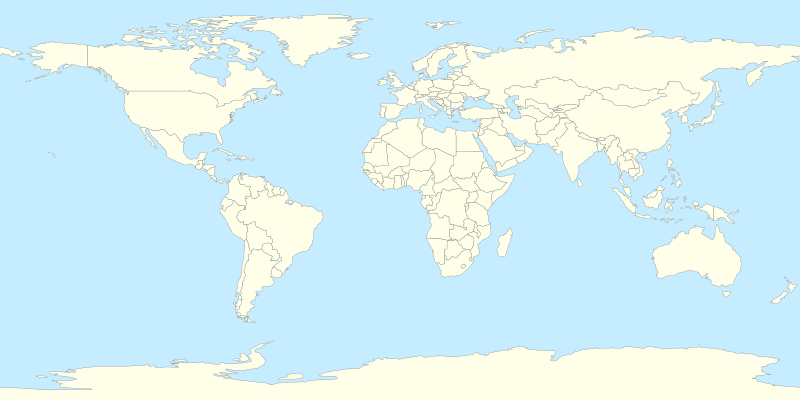 Strait of HormuzIndiaStrait of HormuzIranSaudi ArabiaAfghanistanPakistanStrait of Hormuz
📌 Why in News?
A new freshwater crab species, Ghatiana karnataka, has been scientifically described from Mookambika Wildlife Sanctuary, Udupi, Karnataka. It was discovered by a beat forester and described with a scientist from the **Zoological Survey **of India (ZSI). Location: Mookambika Wildlife Sanctuary, Central Western Ghats, Karnataka.
Syllabus & Relevance
Prelims: Environment — institutions, terminology and factual features connected with the development.
Mains: GS-3 — contemporary application of the relevant syllabus theme.
Current–static link: Revise the underlying institution, policy or concept together with this development.
Why it matters for India
It was discovered by a beat forester and described with a scientist from the **Zoological Survey **of India (ZSI).
The Ministry of Earth Sciences (MoES) highlighted the progress and future roadmap of Mission Mausam, aimed at making India a “Weather-ready and Climate-smart Nation.” Prelims Trap: Hara forests are in Iran’s Persian Gulf region, not India’s Sundarbans.
Static Foundation
Location: Mookambika Wildlife Sanctuary, Central Western Ghats, Karnataka.
It is the 15th known species of the genus Ghatiana in the Western Ghats.
Eight species, including the newly described one, are endemic to Karnataka.
Appearance: Dark-purple body with light-pink claws.
Habitat: Perennial streams and evergreen/semi-evergreen forests.
During monsoon, it occurs around laterite rocks; in other seasons, it shelters in moist tree cavities.
Freshwater crabs are sensitive to habitat alteration and pollution.
Data, Reports, Cases & Examples
It is the 15th known species of the genus Ghatiana in the Western Ghats.
The Ministry of Earth Sciences (MoES) highlighted the progress and future roadmap of Mission Mausam, aimed at making India a “Weather-ready and Climate-smart Nation.”
Initial outlay: ₹2,000 crore for 2024–25 and 2025–26.
Implementing Ministry: Ministry of Earth Sciences.
The mission is particularly relevant for cyclones, floods, heatwaves, lightning and thunderstorms, while also benefiting agriculture, fisheries and aviation.
PRID=2298819®=3&lang=1&utm_source=chatgpt.com
Prelims Quick Facts
A new freshwater crab species, Ghatiana karnataka, has been scientifically described from Mookambika Wildlife Sanctuary, Udupi, Karnataka.
It was discovered by a beat forester and described with a scientist from the **Zoological Survey **of India (ZSI).
Location: Mookambika Wildlife Sanctuary, Central Western Ghats, Karnataka.
It is the 15th known species of the genus Ghatiana in the Western Ghats.
Eight species, including the newly described one, are endemic to Karnataka.
Appearance: Dark-purple body with light-pink claws.
Habitat: Perennial streams and evergreen/semi-evergreen forests.
During monsoon, it occurs around laterite rocks; in other seasons, it shelters in moist tree cavities.
Mains-only layer✍️ Open Mains Perspective & Answer FrameworkClick to expand ↓
Mains Perspective
Background and key dimensions
- Eight species, including the newly described one, are endemic to Karnataka.
- Appearance: Dark-purple body with light-pink claws.
- Habitat: Perennial streams and evergreen/semi-evergreen forests.
- During monsoon, it occurs around laterite rocks; in other seasons, it shelters in moist tree cavities.
- Freshwater crabs are sensitive to habitat alteration and pollution.
- The new species can therefore serve as an indicator of relatively undisturbed freshwater–forest ecosystems.
- The discovery also highlights the still-underexplored biodiversity of the Western Ghats.
- Map linkage: Western Ghats → Karnataka → Udupi → Mookambika Wildlife Sanctuary.
- Conceptual linkage: Western Ghats → high endemism → freshwater biodiversity → habitat sensitivity → conservation.
- PM-JANMAN: Strengthening Development of PVTGs
- The Ministry of Earth Sciences (MoES) highlighted the progress and future roadmap of Mission Mausam, aimed at making India a “Weather-ready and Climate-smart Nation.”
- Initial outlay: ₹2,000 crore for 2024–25 and 2025–26.
Analytical use
- Connect the development with its institutional, policy, economic, social, environmental or security implications only where supported above.
- In a Mains answer, separate the verified development from broader evaluation and use the named evidence precisely.
Way forward
- Base recommendations on the gaps and institutional responsibilities identified in the source-grounded points.
Answer Framework
Introduction
Begin with the immediate development and identify the central institution or policy issue.
Body
- Explain the relevant static concept.
- Present the principal source-backed facts.
- Analyse significance for India and the syllabus theme.
- Discuss supported challenges or implementation gaps.
- Use one named law, report, institution, date or example from the evidence box.
Conclusion
End with a balanced, institutionally feasible way forward without making claims beyond the available evidence.
Possible Mains Question
Examine the significance of “Environment & Ecology
- Biodiversity & Wetlands”. Discuss its key implications and the way forward.