Map focus
33.90°, 67.70° · maps only where geography mattersAfghanistan
CountryAfghanistan
World locator
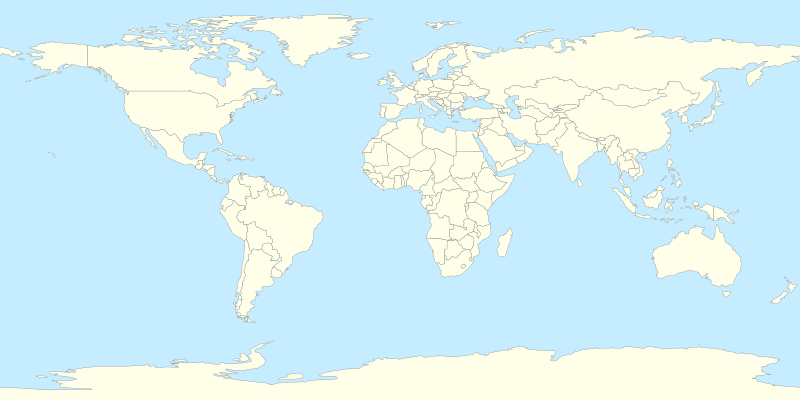 Afghanistan
India context
IndiaAfghanistanRegional countries
PakistanUzbekistanIranKazakhstanAfghanistanNearby: Pakistan · Uzbekistan · Iran · Kazakhstan
📌 Why in News?
CURRENT **AFFAI****RS 34 **India-Afghanistan Trade Engagement: Connectivity, Humanitarian Commerce and Strategic Economics Category: International Relations, Trade and Regional Connectivity | GS: GS Paper II, GS Paper III | Date: 2 September 2026 WHY IN NEWS
- India and Afghanistan held a Joint Working Group meeting on trade in September 2026 to review measures for strengthening bilateral commercial cooperation.
- The engagement is significant because economic links with Afghanistan operate under unusual geopolitical constraints
- including the absence of direct land access through Pakistan, sanctions-related caution, banking difficulties and political uncertainty.
- For India, Afghanistan is simultaneously a neighbourhoodpolicy issue, a Central Asian gateway question, a humanitarian partner and a market for pharmaceuticals, food products, textiles and development-linked commerce.
- The UPSC value lies in connecting trade with strateGIc autonomy, connectivity corridors, Chabahar, reGIonal stability, people-to-people ties and India's long-standing development partnership. TOP DATA & FACTS FOR UPSC u India and Afghanistan are not geographically contiguous in practical trade terms because overland access is constrained by Pakistan. u Chabahar Port in Iran is strateGIcally important for India's access toward Afghanistan and Central Asia without relying on Pakistani transit. u Afghanistan is landlocked, making transport cost, border procedures and reGIonal corridors decisive determinants of trade competitiveness. u India has historically exported pharmaceuticals, medical products, textiles, machinery, food preparations and consumer goods to Afghanistan. u Afghan exports to India have included dry fruits, nuts, asafoetida, saffron and agricultural produce. u Air-freight corridors were previously used to overcome land-transit constraints for high-value and perishable goods. u Afghanistan's location connects South Asia, Central Asia and West Asia, GIving it potential transit significance far beyond the size of its domestic economy. u Banking and payment channels are a major bottleneck in politically sensitive trade environments. u Humanitarian commerce is distinct from political recognition: countries can maintain people-centred economic and aid engagement while calibrating formal diplomatic relations. u Connectivity projects have strateGIc value only when customs, insurance, banking, security and last-mile loGIstics work together. HISTORICAL PERSPECTIVE
- India and Afghanistan share centuries of civilisational, commercial and cultural interaction through routes linking the subcontinent with Central Asia.
- Post- 2001 , India became a major development partner, supporting infrastructure, health, education, capacity building and the Afghan Parliament building, among other projects.
- The Zaranj-Delaram highway, built with Indian assistance, improved Afghanistan's connection toward the Iranian border and the Chabahar route.
- India's approach has generally emphasised Afghan sovereignty, development and people-to-people ties while opposing terrorism and externally imposed instability.
- After the political change in Kabul in 2021 , India's engagement became more calibrated, with humanitarian assistance and functional contacts continuing despite unresolved recognition and security questions. ECONOMIC, GEOGRAPHICAL & ENVIRONMENTAL PERSPECTIVE
- Trade with Afghanistan is constrained by high loGIstics costs.
- A product may be competitive at factory gate but lose competitiveness through multiple trans-shipments, insurance premiums and payment friction.
- Chabahar can reduce strateGIc dependence on a single transit route and can connect Indian shipping with Iran's road and rail networks toward Afghanistan and Central Asia.
- Agricultural imports such as dry fruits and saffron support Afghan rural livelihoods, while Indian medicines and essential goods can serve welfare needs.
- This creates a trade relationship with a strong human-development dimension.
- Geographically, Afghanistan's Hindu Kush terrain and landlocked location raise transport costs.
- Border crossings and mountain routes are vulnerable to weather, insecurity and political closure.
- Environmentally, trade in water-intensive crops and food products should be understood against Afghanistan's drought vulnerability and fraGIle water systems.
- Climate shocks can quickly affect agricultural output and food security.
- Formal trade channels are preferable to opaque informal routes because they improve customs revenue, product standards, traceability and financial compliance.
- DiGItal documentation, e-certification and predictable customs rules can lower transaction costs even where physical geography cannot be changed. SOCIAL PERSPECTIVE
- Indian scholarships, medical treatment and educational links have historically built social capital beyond state-to-state diplomacy.
- Afghan women and vulnerable communities are disproportionately affected by economic isolation.
- Carefully designed humanitarian trade can support livelihoods without normalising rights violations.
- People-to-people commerce in food, medicine, education and small business can preserve societal links during political uncertainty.
- Migration and refugee pressures are influenced by economic opportunity.
- A functioning reGIonal economy can reduce some push factors, although security and rights remain independent determinants. POLITICAL & GOVERNANCE PERSPECTIVE
- India must distinguish engagement from endorsement.
- Functional trade talks can protect Indian interests and Afghan welfare without resolving the question of formal political recognition.
- Pakistan's geography GIves it leverage over traditional transit, making alternative connectivity an element of India's strateGIc autonomy.
- Iran is indispensable to the Chabahar pathway, requiring India to navigate relations with Tehran alongside Western sanctions and wider West Asian geopolitics.
- Central Asian republics also have an interest in stable Afghan transit routes, creating possibilities for minilateral economic cooperation.
- Counter-terrorism remains a red line.
- Commercial engagement cannot come at the cost of ignoring the use of Afghan territory by groups hostile to India. EXAMPLES, CASE STUDIES & **ANSWER-**WRITING VALUE
- Example: Chabahar is strateGIcally valuable because it GIves India maritime access to Iran and onward connectivity toward Afghanistan.
- Yet a port alone is not a corridor
- roads, customs, banking and political predictability determine whether cargo actually moves.
- Trade-finance perspective: exporters need letters of credit, settlement channels, insurance and compliance clarity.
- Where correspondent banking is weak, even willing buyers and sellers may be unable to complete transactions.
- Food-security perspective: Afghanistan's drought exposure makes food imports and agricultural trade politically sensitive.
- India can use humanitarian shipments and commercial trade as complementary tools while avoiding dependency-oriented policy .
- Central Asia perspective: a stable Afghanistan could shorten routes linking South Asia with energy- and mineral-rich Central Asia.
- Instability instead turns geography from an asset into a barrier.
- Security perspective: narcotics trafficking, arms flows and terrorism can exploit the same corridors used by leGItimate commerce.
- Trade facilitation therefore requires customs intelligence and financial monitoring without choking lawful small business.
- Soft-power perspective: Indian medicines, education and cultural links have generated goodwill.
- Economic engagement can preserve this social capital during periods when formal diplomacy is constrained.
- Gender perspective: restrictions on women's education and employment reduce Afghanistan's human capital and long-run growth potential.
- Economic normalisation without attention to inclusion would leave a major structural constraint untouched.
- StrateGIc-autonomy perspective: India should maintain diversified reGIonal relationships so that access to Afghanistan does not depend entirely on the policies of any single transit state.
- International-law perspective: trade engagement must comply with UN sanctions and domestic financial regulations.
- Targeted sanctions are different from a comprehensive trade embargo
- therefore compliant humanitarian and commercial channels can often continue if counterparties and transactions are screened carefully.
- Connectivity-economics perspective: corridors generate network effects.
- Once regular cargo volumes rise, shipping frequency, warehousing and loGIstics services improve, lowering average cost.
- Conversely, low volumes create a vicious cycle of high cost and irregular service.
- Policy should therefore aggregate cargo and provide predictable schedules.
- Development perspective: Afghanistan's private sector is dominated by small enterprises and agriculture.
- Trade facilitation that benefits only a narrow set of large intermediaries will have limited welfare impact.
- Producer cooperatives, quality support and transparent border procedures can distribute gains more widely.
- ReGIonal-security perspective: economic opportunity cannot by itself eliminate extremism, but persistent unemployment, illicit economies and weak state capacity can create permissive environments for criminal and militant networks.
- Legal trade should therefore be seen as one element of a wider stability strategy.
- Example for answers
- India's wheat and medicine assistance, the Chabahar route and earlier air-freight corridors illustrate three different instruments
- humanitarian supply, multimodal strateGIc connectivity and high-value direct trade
- that can be combined according to political conditions.
- Domesticpolicy perspective: Indian exporters need a single, regularly updated advisory on permissible counterparties, payment routes and documentation.
- Uncertainty can produce over-compliance, where banks refuse lawful transactions simply because rules are difficult to interpret.
- Long-run perspective: Afghanistan's greatest economic advantage is location, but location becomes valuable only with peace and institutions.
- India's policy should therefore preserve connectivity options today while avoiding infrastructure assumptions that depend on immediate political normalisation. PROS / SIGNIFICANCE
- Trade sustains people-to-people ties and supports Afghan livelihoods.
- Alternative corridors strengthen India's strateGIc connectivity to Central Asia.
- Indian pharmaceuticals and services can contribute to humanitarian welfare.
- Formal commerce improves transparency compared with informal smuggling networks.
- Economic engagement GIves India a continuing stake and presence in reGIonal developments. CONS / CHALLENGES
- Political instability and sanctions-related caution increase banking and insurance costs.
- Security threats can disrupt corridors and expose businesses to loss.
- Absence of direct land access makes Indian trade structurally expensive.
- Human-rights concerns complicate deeper engagement.
- Overdependence on any single corridor creates geopolitical vulnerability. WAY FORWARD
- Prioritise low-risk, high-welfare sectors such as medicines, food, agricultural products, education and essential consumer goods.
- Strengthen Chabahar-linked multimodal loGIstics and coordinate customs procedures with Iran and reGIonal partners.
- Develop compliant payment mechanisms that satisfy anti-money-laundering and sanctions requirements while allowing leGItimate trade.
- Use diGItal certificates of oriGIn, phytosanitary documentation and trade facilitation to reduce procedural friction.
- Support Afghan small producers through standards, packaGIng and market-access programmes where feasible.
- Maintain a calibrated diplomatic posture: engage on trade, humanitarian needs and security while linking deeper normalisation to inclusive governance and counter-terror commitments.
- Integrate Afghanistan policy with India's wider Central Asia strategy rather than treating it as an isolated bilateral file. PRELIMS QUICK REVISION u Afghanistan is landlocked. u Chabahar Port is in Iran and provides India an alternative route toward Afghanistan/Central Asia. u Zaranj-Delaram highway is important to the Iran-Afghanistan connectivity chain. u Trade policy and diplomatic recognition are conceptually distinct. u Connectivity requires physical infrastructure plus customs, banking, insurance and security. PROBABLE MAINS QUESTION India's economic engagement with Afghanistan illustrates how connectivity can function as an instrument of both humanitarian policy and strateGIc autonomy. Discuss
background
from India's regional connectivity policy. SOURCES
- Sources used for factual grounding: PIB
- Ministry of Commerce & Industry, 2 September 2026
🎯
Exam map
Syllabus & Relevance
Paper: GS Paper II, GS Paper III
Theme: International Relations, Trade and Regional Connectivity
🎯
Rapid revision
Prelims Quick Facts
Prelims facts will be updated soon.