Map focus
22.80°, 79.00° · maps only where geography mattersIndia
CountryIndia
India locator
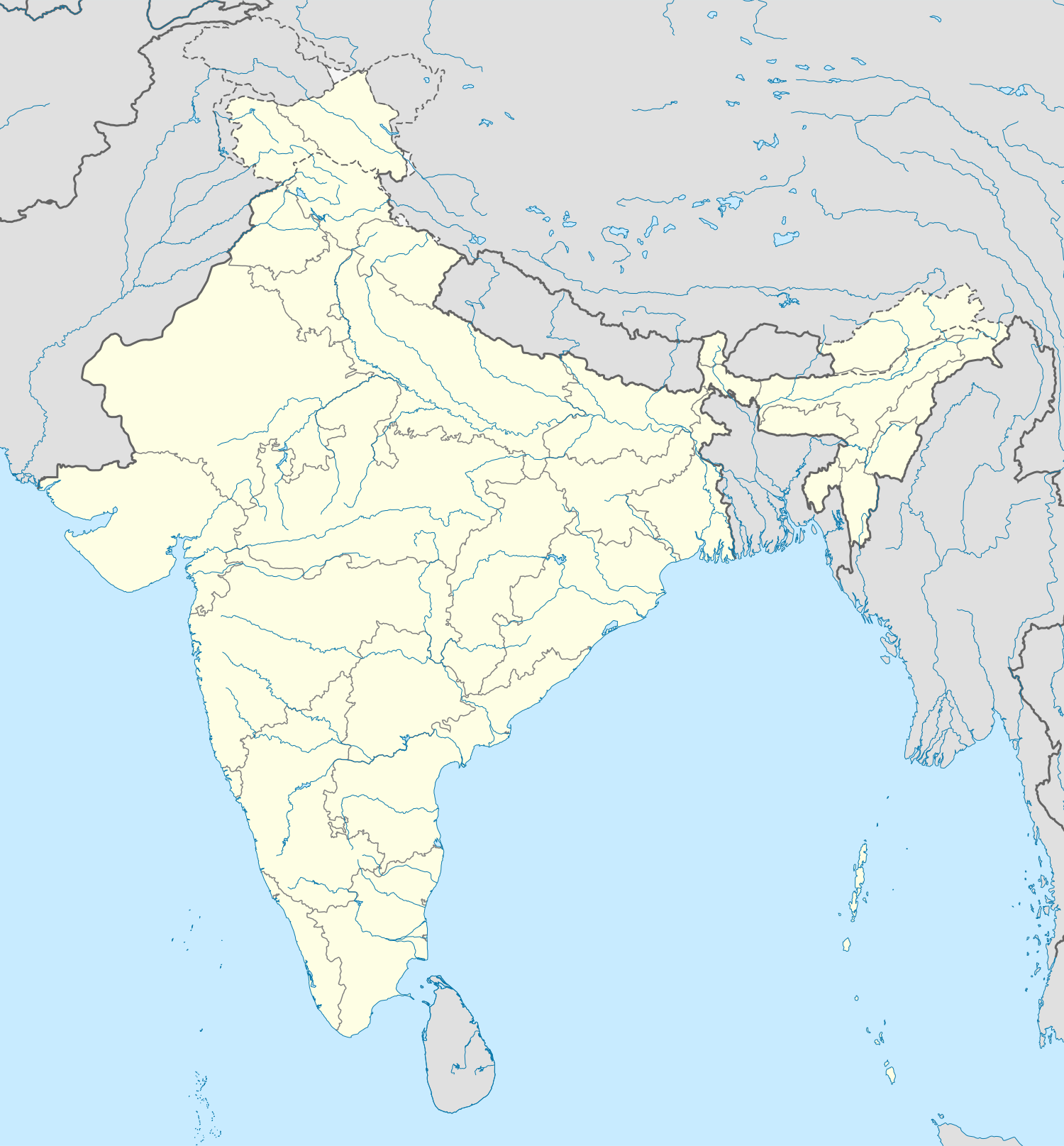 India
India📌 Why in News?
CURRENT **AFFAI****RS 32 **India's Nuclear Energy Expansion: Green Finance, Private Participation and the 100 GW by 2047 Roadmap Category: Energy, Economy, Environment and Science & Technology | GS: GS Paper II, GS Paper III | Date: 2 September 2026 WHY IN NEWS
- India's nuclear-energy transition has moved from a capacity-expansion question to a financing, technology and human-capital question.
- Officials and industry leaders have argued that India's green-finance architecture should recognise nuclear power if the country is to mobilise the very large investment required for the Nuclear Energy Mission .
- India is targeting 100 GW of nuclear capacity by 2047 , compared with about 8.78 GW at present.
- The official roadmap envisages about 22 GW by 2031-32 , followed by a much larger build-out involving NPCIL , other public enterprises, State entities, joint ventures and private participation.
- The issue is important for UPSC because it links energy security, climate mitigation, industrial policy , strateGIc technology, federal regulation, liability, green taxonomy, skilled employment and India's Net Zero 2070 pathway. TOP DATA & FACTS FOR UPSC u Target: 100 GW nuclear capacity by 2047 under the Nuclear **Energy Mission **for Viksit Bharat . u Present installed nuclear capacity is about 8.78 GW , excluding RAPS-I in official comparisons. u Official roadmap: about 22 GW by 2031-32 as projects under implementation are completed. u Another 32 GW is envisaged beyond 2032 through NPCIL , taking the NPCIL -linked pathway to roughly 54 GW u the balance is expected from other public, State, private and joint-venture models. u Nuclear power supplied about 3.1% of India's electricity generation in 2024
- 25 . u At least five indigenous Small Modular Reactors are targeted for development and operationalisation by 2033 . u BARC designs include the 220 MWe Bharat Small Modular Reactor , 55 MWe SMR-55 and a high-temperature gas-cooled reactor concept for hydrogen production. u Industry estimates cited in September 2026 place required investment near US$210 billion for the scale-up. u Nuclear projects typically have long project/construction periods of around 10-12 years , making financing cost and regulatory certainty critical. u India's climate commitment is Net Zero by 2070 u nuclear offers low-carbon, firm power that can complement variable solar and wind generation. HISTORICAL PERSPECTIVE
- India's nuclear programme was designed around long-term technoloGIcal autonomy.
- Homi J.
- Bhabha's three-stage strategy sought to use India's limited uranium and large thorium resources through pressurised heavy-water reactors, fast breeder reactors and eventually thorium-based systems.
- The Atomic Energy Act, 1962 created a tightly controlled framework with the Union at the centre of atomic-energy development.
- For decades, nuclear generation remained overwhelmingly a public-sector domain.
- The 2005 India-US civil nuclear initiative and the 2008 Nuclear Suppliers Group waiver ended India's long isolation from global civil nuclear commerce despite India remaining outside the Nuclear Non-Proliferation Treaty .
- The Civil Liability for Nuclear Damage Act, 2010 established a liability framework, including operator liability and a statutory right of recourse in specified circumstances.
- Supplier concerns over liability became one factor affecting imported-reactor negotiations.
- Recent policy has shifted from incremental public-sector expansion toward a mission -mode ecosystem involving indigenous PHWRs , imported advanced reactors, SMRs, brownfield repurposing and wider participation. ECONOMIC, GEOGRAPHICAL & ENVIRONMENTAL PERSPECTIVE
- Nuclear power has high upfront capital cost but low fuel cost and long operating life.
- Once commissioned, plants can provide large q UAN tities of firm electricity with high capacity factors, reducing the need for fossil-fuel balancing.
- A 100 GW programme could create a domestic supply chain in heavy enGIneering, special steels, control systems, pumps, turbines, nuclear-grade components, construction, cyber security and specialised services.
- This can deepen Make in India rather than treating nuclear plants as isolated power projects.
- Financing is a central bottleneck.
- If sovereign green bonds, green deposits and sustainable-finance taxonomies exclude nuclear, projects may face a narrower pool of capital and a higher weighted cost of finance.
- Including nuclear requires clear environmental safeguards so that green
- classification remains credible.
- SMRs could serve industrial clusters, data centres, refineries, steel, chemicals and remote grids.
- Their economic promise lies in modular construction and standardisation, although first-of-a-kind units may remain expensive until scale is achieved.
- Geographically, nuclear plants require careful site selection for seismic safety, cooling-water availability, population distribution, evacuation planning and ecoloGIcal sensitivity.
- Coastal sites have cooling advantages but face cyclone, sea-level and marine-ecology considerations.
- Environmentally, nuclear generation has very low operational carbon emissions and small land requirements per unit of electricity.
- However, uranium mining, spent-fuel management, thermal discharge, radioactive waste and decommissioning require life-cycle governance.
- India's closed-fuel-cycle orientation seeks to recover usable material from spent fuel.
- This improves resource efficiency but demands very high standards of safeguards, security and waste management. SOCIAL PERSPECTIVE
- Nuclear projects create skilled jobs but can produce local anxiety over radiation, land acquisition, fishing access, horticulture and livelihood disruption.
- Official responses have therefore increasingly emphasised public outreach and rehabilitation.
- Trust is a social infrastructure.
- Transparent environmental-impact assessment, independent safety communication, local emergency preparedness and disclosure of radiation monitoring are as important as enGIneering safety.
- The skills challenge is significant.
- Nuclear enGIneering, radiation protection, reactor physics, quality assurance, welding, non-destructive testing and regulatory science require long training pipelines.
- A 100 GW programme cannot be sustained only by a few premier institutions.
- Just-transition thinking is relevant where SMRs are proposed at retiring coal sites.
- Existing transmission, water and industrial infrastructure can be reused, but coal workers need reskilling and communities need credible employment pathways. POLITICAL & GOVERNANCE PERSPECTIVE
- Atomic energy is constitutionally and strateGIcally dominated by the Union, but land, water, local infrastructure, policing, disaster management and rehabilitation require State cooperation.
- Expansion therefore has an implicit cooperative-federalism dimension.
- Private participation can mobilise capital and technology, but the State must retain uncompromised authority over safety, security, safeguards and radioactive materials.
- Commercial liberalisation cannot mean regulatory dilution.
- India must balance strateGIc autonomy with international technology partnerships.
- Imported reactor technology can accelerate deployment, while indigenous PHWRs and SMRs reduce external dependence.
- Nuclear diplomacy also strengthens partnerships with countries such as France, Russia and the United States, while India's record on non-proliferation supports access to global nuclear commerce. EXAMPLES, CASE STUDIES & **ANSWER-**WRITING VALUE
- Examples and answer-writing value: Kudankulam demonstrates the role of international reactor cooperation
- Kakrapar illustrates the scaling of indigenous 700 MWe PHWR technology
- Kalpakkam represents India's fast-breeder ambition.
- These examples allow a Mains answer to move from abstract policy to technology-specific evidence.
- Energy-system perspective: as solar generation rises during daytime, India needs flexible grids, storage, demand response and firm low-carbon capacity.
- Nuclear is not highly flexible in every configuration, but dependable baseload can reduce the amount of fossil generation required to maintain reliability.
- StrateGIc-material perspective: uranium security, enrichment-related technoloGIes, heavy-water capability and domestic fuel-cycle expertise are connected to strateGIc autonomy.
- India has therefore pursued diversified uranium supply relationships while retaining indigenous technoloGIcal capabilities.
- Climate-finance perspective: a green taxonomy should avoid a simplistic renewable-versus-nuclear binary.
- The relevant tests are lifecycle greenhouse-gas intensity, safety, waste, biodiversity impact, water use, additionality and compatibility with a credible transition pathway.
- Disaster-management perspective: site-specific emergency plans, exclusion zones, off-site response, radiation monitoring, hospital preparedness and public communication must be rehearsed.
- Fukushima showed that compound natural hazards can challenge assumptions even where reactor enGIneering is sophisticated.
- Water perspective: thermal power plants, including nuclear stations, need cooling.
- In water-stressed reGIons, cooling technology and siting become climate-adaptation questions.
- Coastal plants reduce freshwater pressure but require marine-ecology safeguards.
- Industrialpolicy perspective: India should maximise domestic value addition in forGIngs, reactor components, control systems and construction while avoiding protectionism that locks projects into inferior technology.
- StrateGIc localisation should be performance-based.
- Governance perspective: public acceptance depends on independent regulation.
- The regulator must possess technical capability, inspection authority , transparent reporting and institutional distance from the entities responsible for promoting nuclear power. PROS / SIGNIFICANCE
- Firm low-carbon electricity can complement solar and wind and reduce dependence on coal.
- High energy density lowers land requirement relative to many utility-scale alternatives.
- Domestic reactor manufacturing can generate advanced industrial capabilities and skilled employment.
- SMRs may enable decarbonisation of hard-to-abate industrial loads and brownfield coal sites.
- Greater nuclear output can improve energy security by diversifying the generation mix. CONS / CHALLENGES
- Very high capital cost and long construction periods create financing and execution risks.
- Accident risk is low-probability but potentially high-impact, making safety culture non-negotiable.
- Radioactive waste requires secure management across very long time horizons.
- Land, cooling water and local livelihood conflicts can delay projects.
- Technology import dependence, liability concerns and cost overruns can weaken project economics.
- A rapid build-out without a parallel regulator-and-skills expansion could create institutional bottlenecks. WAY FORWARD
- Create a transparent Indian sustainable-finance taxonomy that evaluates nuclear on life-cycle emissions, waste, safety and do-no-significant-harm criteria rather than excluding it by label.
- Sequence capacity additions realistically
- complete projects already under construction, standardise the 700 MWe PHWR fleet, demonstrate indigenous SMRs, and use imported reactors selectively where economics and technology transfer are favourable.
- Expand university programmes, apprenticeships and vendor certification in nuclear enGIneering, safety, quality assurance and advanced manufacturing.
- Strengthen regulatory independence, staffing, emergency preparedness and public disclosure as capacity expands.
- Develop credible spent-fuel, waste-storage and decommissioning financing plans before plants enter service.
- Use local-benefit frameworks
- jobs, health systems, infrastructure, fisheries support and transparent compensation
- to build durable community consent.
- Treat nuclear, renewables, storage, grids and efficiency as complementary pillars of a diversified clean-energy system rather than ideoloGIcal substitutes. PRELIMS QUICK REVISION u Nuclear **Energy Mission **target: 100 GW by 2047 . u Present capacity: about 8.78 GW u roadmap: about 22 GW by 2031-32 . u SMR goal: at least five indigenous SMRs by 2033 . u PHWR = Pressurised Heavy Water Reactor u SMR = Small Modular Reactor. u Nuclear energy is low-carbon firm power but radioactive-waste governance remains essential. PROBABLE MAINS QUESTION India's nuclear-energy ambition is simultaneously an energy-security project, a climate strategy and an advanced-manufacturing mission. Discuss the financing, regulatory, environmental and social conditions required to achieve 100 GW by 2047. Reuters, 2 September 2026. SOURCES
- Sources used for factual grounding: PIB
- Department of Atomic Energy parliamentary replies, July-August 2026
🎯
Exam map
Syllabus & Relevance
Paper: GS Paper II, GS Paper III
Theme: Energy, Economy, Environment and Science & Technology
🎯
Rapid revision
Prelims Quick Facts
Prelims facts will be updated soon.