Map focus
22.80°, 79.00° · maps only where geography mattersIndia
CountryIndia
India locator
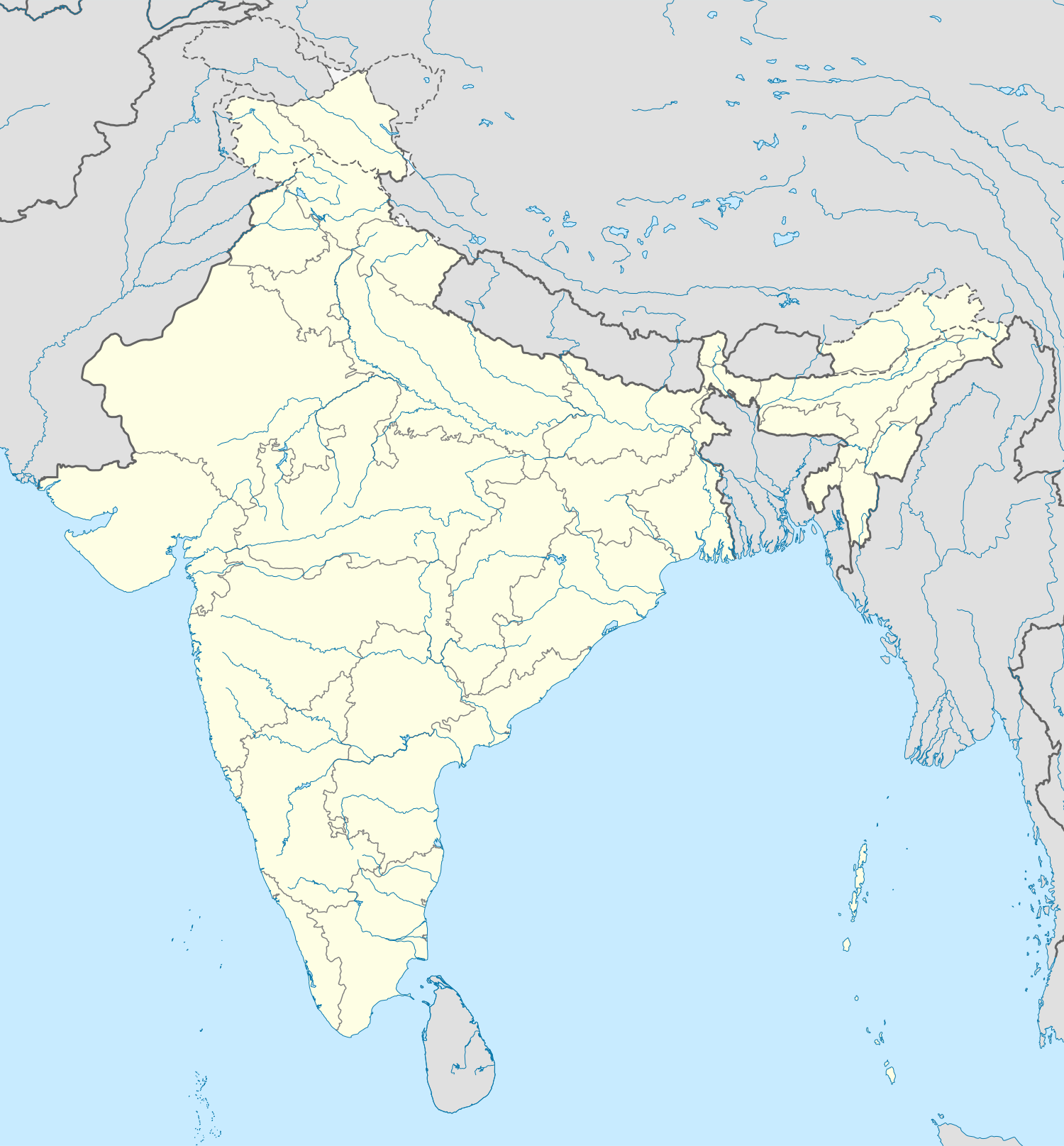 India
India📌 Why in News?
Economy CA_CATEGORY: Environment, Water and Urbanisation CA_GS: GS Paper II, GS Paper III CA_DATE: 31 August 2026 CA_IMAGE: NO Safe Reuse of Treated Wastewater: 3% Reuse, 126.45 MLD Prayagraj Potential and India's Circular Water Economy Why in News?
- Safe Reuse of Treated Wastewater is emerging as a national urban-water priority as freshwater scarcity, sewage pollution and industrial demand intensify.
- NITI Aayog has noted that less than 1,000 MLD, about 3% of treated wastewater and around 1% of total wastewater generated, was being reused for valuable purposes in the baseline assessment it cited.
- Recent city-level reuse plans under the Ganga framework show how treated sewage can substitute freshwater in power plants, railways, landscaping and selected irrigation uses. Prayagraj
- Project-Level Numbers
- Prayagraj's identified reuse projects together represent 126.45 MLD of potential treated-water reuse with estimated investment of about ₹1,625 crore.
- Naini STP III to Prayagraj Power Generation Company has a proposed reuse link of 50 MLD.
- Naini I and II STPs to Meja Urja Nigam have a proposed combined reuse of 72 MLD.
- Railway reuse projects include 3.32 MLD from Rajapur STP to Prayagraj Junction and 1.13 MLD from Kodra STP to Subedarganj Railway Station. Agra
- Sewage and Reuse Data
- Agra generates about 286 MLD of sewage, and nearly 21% was reported as remaining untreated in the city reuse plan.
- Existing sewage-treatment capacity of 221 MLD is planned to rise to 398 MLD, which would create headroom above present sewage generation if plants operate effectively.
- Identified reuse includes 5 MLD to Agra Cantt, Agra Fort and Idgah railway stations, 2 MLD to a Medical College Metro corridor and 21 MLD toward Keetham Jheel.
- These projects together operationalise about 28 MLD reuse potential with estimated investment of ₹93 crore. Kanpur Example
- The Bingawan Sewage Treatment Plant in Kanpur has capacity of 30 MLD and has operated since June 2023.
- It was developed under the Hybrid Annuity Model and uses Sequential Batch Reactor technology.
- HAM can improve lifecycle accountability because part of private payment is linked to operation and performance rather than only construction.
- Even where sewage is treated, reuse can remain low if distribution pipelines and buyers for treated water are absent. AMRUT 2.0 Targets
- AMRUT 2.0 was designed to move toward universal urban water-supply coverage and 100% sewerage/septage coverage in 500 AMRUT cities.
- The mission envisaged 2.68 crore urban household tap connections benefiting around 10.7 crore people and 2.64 crore sewer/septage connections benefiting around 10.6 crore people.
- Recycle and reuse of treated wastewater is intended to meet about 20% of total city water needs and 40% of industrial water demand under the mission vision.
- City Water Balance Plans are a key circular-economy instrument for matching water sources, consumption, sewage generation and reuse. Circular Water Economy
- A linear city extracts freshwater, uses it once, treats some sewage and discharges it; a circular city treats wastewater to fit-for-purpose quality and reuses it.
- Industrial cooling, construction, railways, landscaping and some agricultural uses often do not require drinking-water quality.
- Substituting treated wastewater in these sectors preserves higher-quality freshwater for households and ecosystems.
- Reuse also reduces nutrient and pollutant loads discharged into rivers. Fit-for-Purpose Treatment
- Water quality should match the end use: irrigation, cooling towers, construction and groundwater recharge have different chemical and microbiological requirements.
- Over-treating all wastewater to potable standards wastes energy and money; under-treatment creates health and soil risks.
- Standards must consider pathogens, salinity, heavy metals, nutrients and industrial contaminants.
- Regular monitoring is essential because treatment-plant performance can fluctuate. Economics of Reuse
- A treatment plant without a reuse network may still discharge most treated water into a river; therefore, pipelines and off-take contracts are part of the project, not an afterthought.
- Tariffs must be attractive enough for industries to switch from freshwater while still covering operation and distribution costs.
- Long-term purchase agreements with power plants, railways or large industries can improve revenue certainty.
- ₹1,625 crore for 126.45 MLD in Prayagraj illustrates the capital intensity of building a reuse network, not only the STP itself. Groundwater Link
- Industrial substitution of treated wastewater can reduce pressure on urban and peri-urban aquifers.
- Managed aquifer recharge is possible in selected settings but requires stringent water-quality safeguards to avoid contaminating groundwater.
- Over-extraction can cause falling water tables, higher pumping energy and land subsidence in susceptible geological settings.
- Urban water security therefore requires integrated management of surface water, groundwater, rainwater and treated wastewater. Namami Gange Link
- Safe reuse is being integrated with river rejuvenation because treated sewage that is productively reused does not enter rivers as discharge.
- City-Level Reuse Action Plans have been completed for Agra, Prayagraj and Varanasi under the Ganga framework.
- By July 2026, the number of Ramsar wetlands within the Ganga Basin was reported to have reached 35, adding a wetland-conservation dimension to river-basin planning.
- Aviral Ganga relates to ecological flow; Nirmal Ganga relates to pollution reduction. Health and Agriculture
- Irrigation reuse can supply both water and nutrients, but untreated or poorly treated sewage can expose farmers and consumers to pathogens and contaminants.
- Salinity and sodium can degrade soil structure if unsuitable water is applied repeatedly.
- Crop restrictions and irrigation methods can reduce exposure for certain reuse applications.
- Public-health agencies and agriculture departments therefore need to participate in water-reuse regulation, not only urban utilities. Way Forward
- Mandate city water-balance and reuse plans for water-stressed urban areas.
- Create quality classes for different reuse purposes and publish continuous compliance data.
- Build dedicated reuse pipelines alongside new STPs so treatment capacity automatically creates a marketable water resource.
- Use long-term industrial off-take contracts and rational freshwater pricing to make reuse financially viable.
- Track litres of freshwater actually displaced, rather than reporting only MLD of treatment capacity. Prelims Quick Revision
- Baseline productive reuse cited by NITI Aayog: less than 1,000 MLD; about 3% of treated wastewater and 1% of wastewater generated.
- Prayagraj reuse potential: 126.45 MLD; estimated investment ₹1,625 crore.
- Agra sewage generation: 286 MLD; existing STP capacity 221 MLD; planned 398 MLD.
- Agra identified reuse: 28 MLD; estimated ₹93 crore.
- AMRUT 2.0 vision: reuse can meet 20% of city water needs and 40% of industrial demand. Probable Mains Question India's urban wastewater challenge is increasingly an issue of resource recovery rather than disposal alone. Examine the opportunities and safeguards required for a circular water economy.
🎯
Exam map
Syllabus & Relevance
Paper: GS-3
Theme: Environment
🎯
Rapid revision
Prelims Quick Facts
Prelims facts will be updated soon.