Map focus
22.80°, 79.00° · maps only where geography mattersIndia
CountryIndia
India locator
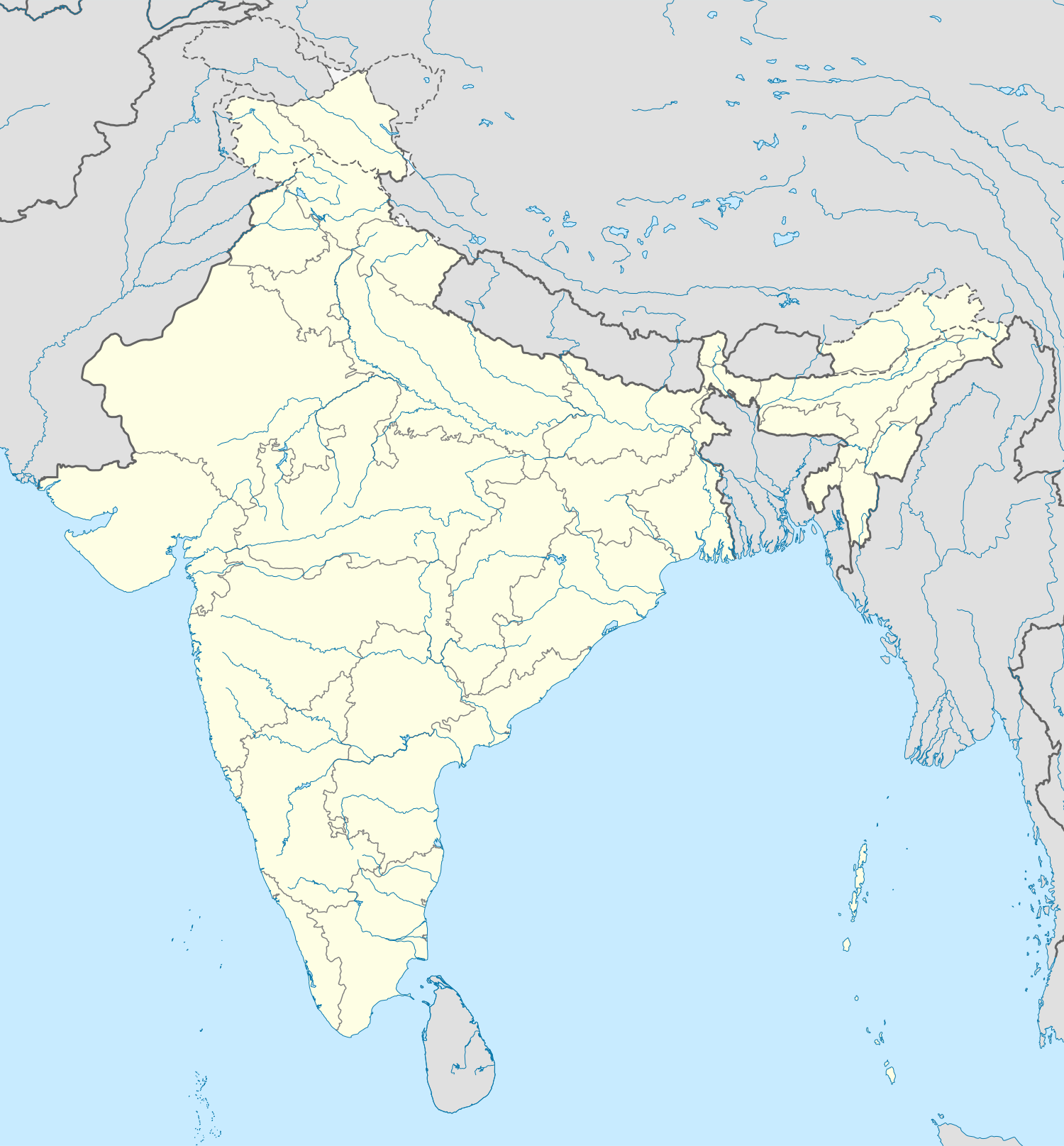 India
India📌 Why in News?
Military-Industrial Ecosystem CA_CATEGORY: Defence and Economy CA_GS: GS Paper II, GS Paper III CA_DATE: 31 August 2026 CA_IMAGE: NO Sixth Positive Indigenisation List: 405 Defence Items, ₹3,070 Crore Business Potential and India's Military-Industrial Ecosystem Why in News?
- The Department of Defence Production notified the sixth Positive Indigenisation List in August 2026 containing 405 strategically important items with estimated business potential of ₹3,070 crore.
- The list includes 389 items for Defence Public Sector Undertakings and 16 items for the Indian Coast Guard.
- Items include line-replaceable units, sub-systems, sub-assemblies, spares, components and raw materials across aircraft, armoured vehicles, warships and missile systems. Platforms Covered
- Air-platform items relate to systems such as Advanced Light Helicopter, Light Utility Helicopter, Su-30MKI, Light Combat Aircraft and the AL-31FP engine.
- Armoured-platform items cover systems linked to T-72, T-90 and BMP-II fleets.
- Missile-related items include systems such as Konkurs-M, Invar and MRSAM.
- Warship components and Coast Guard equipment broaden the list beyond the Army and Air Force, making indigenisation a tri-service and maritime issue. What a Positive Indigenisation List Means
- A Positive Indigenisation List identifies items that are to be sourced from Indian industry after specified timelines rather than imported as a routine option.
- The objective is to create predictable domestic demand so firms can invest in tooling, qualification, testing and production capacity.
- Indigenisation of spares and sub-systems is strategically important because imported platforms can become unavailable during sanctions or wartime supply disruption.
- Domestic sourcing also reduces foreign-exchange outflow, but quality and lifecycle cost remain essential. ₹3,070 Crore
- Why Business Visibility Matters
- Estimated business potential of ₹3,070 crore gives firms a quantifiable market signal for the sixth list alone.
- Defence manufacturing often requires high upfront certification costs and relatively small production runs; predictable orders can improve commercial viability.
- MSMEs can enter supply chains through specialised components, electronics, machining and materials rather than manufacturing complete platforms.
- Public procurement therefore acts as industrial policy when demand visibility is linked to technology and quality standards. Line Replaceable Units
- A Line Replaceable Unit is a modular component designed to be replaced at the operating or maintenance level rather than repaired in place.
- LRUs can include avionics modules, pumps, electronic units and control systems depending on platform design.
- Indigenising LRUs improves fleet availability because replacement inventory can be produced domestically.
- High platform availability is a strategic metric: a large inventory is less useful if critical imported spares keep assets grounded. DPSUs and Private Industry
- Defence Public Sector Undertakings remain major platform integrators, while private companies and MSMEs increasingly supply sub-systems and components.
- Positive lists can widen domestic vendor bases if DPSUs transparently share specifications and qualification pathways.
- Single-source dependence within India can still create vulnerability; genuine indigenisation should develop competitive and resilient supply chains.
- Technology transfer, intellectual-property access and domestic design capability determine the depth of self-reliance. Import Substitution vs Indigenous Design
- Manufacturing an imported design under licence is not the same as owning the underlying design, source code or critical material technology.
- Strategic autonomy is highest when India controls design, testing, upgrades, production and key inputs.
- Component-level indigenisation is still valuable because it can progressively deepen capability around an initially foreign-origin platform.
- Policy should therefore measure indigenous content and intellectual-property depth, not only final assembly location. Missile Technology Transfer
- 2026 Link
- In August 2026 the Defence Ministry also approved transfer of DRDO-developed technologies of conventional missile systems to qualified Indian defence industry for production.
- This can move mature systems from government R&D into larger industrial production.
- Successful transition requires production engineering, quality assurance and configuration control, not merely transfer of drawings.
- Public R&D plus private/DPSU manufacturing can create a broader military-industrial ecosystem. Export Potential
- Domestic scale can make Indian components and systems more competitive for exports, especially to countries operating similar Russian-origin or Indian platforms.
- Defence exports also require end-use controls, geopolitical assessment, after-sales support and compliance with international obligations.
- Export orders can extend production runs and reduce unit cost for domestic procurement.
- A reliable spare-parts ecosystem is often as important to foreign customers as the initial platform sale. Supply-Chain Security
- Modern defence platforms depend on semiconductors, sensors, specialty alloys, explosives, propulsion components and software.
- Indigenising a final component while relying on a single foreign source for a critical chip or material may leave the strategic vulnerability unchanged.
- Supply-chain mapping should identify tier-2 and tier-3 dependencies and build dual sourcing where feasible.
- Cybersecurity and trusted electronics are increasingly part of defence indigenisation. Way Forward
- Publish item-level indigenisation timelines, vendor-development milestones and achieved domestic content.
- Use long-term orders and testing support to bring MSMEs into the ₹3,070 crore opportunity pool.
- Prioritise design ownership and critical technologies rather than simple assembly.
- Create strategic inventories for inputs that cannot yet be manufactured economically in India.
- Link positive lists with export promotion, standards, defence corridors and DRDO technology transfer. Prelims Quick Revision
- Sixth Positive Indigenisation List: 405 items.
- Estimated business potential: ₹3,070 crore.
- 389 items relate to DPSUs; 16 to Indian Coast Guard.
- Platforms include ALH, LUH, Su-30MKI, LCA, T-72, T-90, BMP-II, warships and missile systems.
- Department: Department of Defence Production, Ministry of Defence. Probable Mains Question Defence indigenisation is meaningful only when import substitution evolves into design ownership and resilient domestic supply chains. Discuss with reference to the sixth Positive Indigenisation List.
🎯
Exam map
Syllabus & Relevance
Paper: GS-3
Theme: Defence & Security
🎯
Rapid revision
Prelims Quick Facts
Prelims facts will be updated soon.